
As 2026 approaches, many US taxpayers are starting to wonder how the 2026 income tax brackets will affect their tax deductions. While tax brackets do not directly affect your deductions, they do influence how valuable they are, and how much tax you ultimately save.
With inflation changes, potential policy shifts, and income growth following recent years of economic development, your taxable income may fall into a different bracket in 2026 than it did previously. That implies that the same deduction, whether for retirement contributions, business expenses, or itemized write-offs, may decrease your tax bill more or less than you anticipate.
Understanding income tax brackets in 2026 is important for people and organizations as well. As it allows them to make better tax decisions before it is too late. In this blog, we will explain what tax rates are, what might change in 2026, and how those changes might affect your tax deductions and overall tax strategy, using clear, practical examples that avoid tax complications.
Understanding the 2026 Income Tax Brackets
what is the tax bracket for income
Knowing how the 2026 income tax brackets work makes it easier to understand how different parts of your income are being taxed, so you’re not trying to make an educated guess when taxes are due. A progressive tax system, like the U.S., means that more parts of your income are being taxed at higher rates—not all of it at once. This can help you make informed combinations for a lower tax liability before the close of the year.
Business Income Tax and Tax Brackets
Your business income tax will be based on the profit accruing in the business after taking the deduction allowed by law. Based on the type of business structure the business uses, either proprietorship, partnership, S corp, or C corp, the business income will be taxed based on the tax rates applicable to the business structure used by the business. It will help in proper taxation of the business income by ensuring proper planning based on the business income.
What Is a Tax Bracket?
A tax bracket is an income range that is subject to a specific federal income tax rate. The United States has a progressive tax system, which means that different sections of your income are taxed at different rates rather than all at once.
As your income grows, it goes through each tax band. Lower category income is taxed at a reduced rate, whereas the higher bracket is taxed at a higher rate.
For example, if your income places you in a higher tax bracket in 2026, this does not mean all of your income is taxed at the higher rate. Only income above the bracket threshold is subject to higher taxes.
This is significant since tax deductions reduce your taxable income, frequently lowering the amount taxed at the highest rate. The higher your tax bracket, the more valuable each deduction becomes, so it’s critical to know where your income falls.
Why Being in a “Higher Tax Bracket” Doesn’t Mean All Your Income Is Taxed More?
The federal income tax system in the United States is progressive, meaning that your income is taxed gradually rather than all at once at the highest rate. Only the portion of your income that falls into a higher tax bracket is subject to the higher rate of taxation when you move into that bracket; your full income is not.
Here’s a simple example:
Even if your taxable income puts you in the 24% tax band, not all of your income will be subject to 24% taxation.
As an alternative:
- Lower bracket income is subject to 10%, 12%, or 22% tax.
- Only income over the preceding bracket threshold is subject to a 24% tax.
Because of this, your take-home pay from taxes alone never decreases when you make more money. Even if you pay a higher tax on a portion of your income, you always keep more altogether.
Why this matters for US taxpayers and businesses:
- Increased profits or raises won’t immediately result in greater taxes on all of your income.
- Instead than avoiding higher bands, smart tax planning concentrates on lowering taxable income.
- Even in higher brackets, credits and deductions can still reduce your effective tax rate.
Federal Income Tax Brackets — What May Change in 2026
As the 2026 tax year is on the horizon, there are some significant changes to federal income tax that you should be aware of, especially if you’re planning, saving or working your way through the tax filing process right now. Now these changes aren’t a complete overhaul, they’re primarily down to the annual inflation adjustments and the new tax code rules that kick in come 2026.
1. Inflation-Adjusted Bracket Thresholds:
The IRS updates the federal income tax brackets every year to account for inflation, and lets be honest the rates themselves aren’t changing all that much in 2026. Seven very familiar rates 10%, 12%, 22%, 24%, 32%, 35%, and 37% are sticking around, but the important thing is the income levels that each one kicks in at have all gone up compared to 2025 levels. So the upshot of all this is – all things being equal and we know that inflation is going to push salaries up a bit anyway it might take a bit longer for taxpayers to start getting pushed into higher marginal tax brackets.
For example, under the 2026 tax year (the taxes you’ll file in 2027):
- Taxable income up to around $12,400 (single) and $24,800 (married filing jointly) is subject to the 10% bracket.
- The 12% bracket goes up to roughly $50,400 for singles and $100,800 for couples.
- Elimination points for all filing statuses are likewise higher for higher brackets.
These automatic inflation adjustments are intended to stop “bracket creep,” in which individuals would otherwise pay higher taxes due only to increases in income brought on by inflation.
2. Higher Standard Deductions:
For 2026, the standard deduction, the fixed sum that the majority of taxpayers deduct from their gross income before calculating taxes, also increases. For instance:
- Single filers: approximately $16,100,
- Married filing jointly: around $32,200,
- Head of household: about $24,150.
Higher standard deductions reduce your taxable income and can lower your overall tax bill.
3. New and Expanded Tax Breaks:
The One Big Beautiful Bill Act, a significant tax law passed in 2025, goes into full force in 2026. This bill helps many taxpayers keep more money in their pockets by expanding tax incentives for specific categories. Among them are:
- Expanded child tax credits and revamped deduction rules,
- Additional deductions for senior taxpayers, and
- New break opportunities for tipped and hourly workers
These adjustments might lower your tax burden, which means you might owe less tax even in the same bracket. But they don’t immediately change the bracket rates themselves.
What Does It Mean for Your Taxes?
These modifications may have the following practical effects:
- Slightly higher take-home pay when withholding tables change over the course of the year,
- Decreased chance of getting placed in a higher band due to inflation alone, and
- New provisions in the tax code may result in lower overall tax bills for qualifying households.
Income Tax Brackets 2026 – What Businesses Should Watch
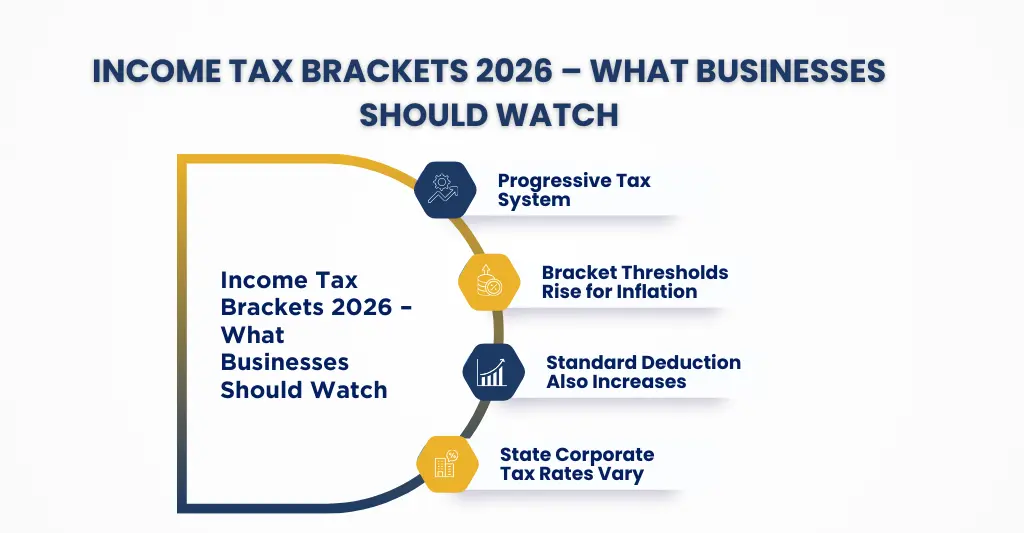
The federal income tax rates for the 2026 tax year (returns filed in 2027) still range from 10% to 37%, but the income limits associated with each bracket have been raised to reflect inflation. This indicates that certain income may be taxed in lower brackets for a longer period of time before reaching the higher rates for enterprises and owners.
Here’s what businesses should keep in mind:
Progressive Tax System Still in Place:
The brackets are still progressive, even for business owners (sole proprietors, partnerships, and S-corps) who report earnings on personal returns; only income that exceeds each level is subject to the subsequent higher rate of taxation.
Bracket Thresholds Rise for Inflation:
Every year, the IRS modifies these levels. This will result in slightly higher cutoffs for each tax rate in 2026, which can lower total tax obligations for business owners whose income is increasing but their taxable income is under control.
Standard Deduction Also Increases:
Increased standard deductions for 2026 reduce taxable income, which is important for small business owners who file individual tax returns.
State Corporate Tax Rates Vary:
Many states maintain or modify their corporate income tax rates and brackets for firms independently of federal brackets. Be aware of changes in state policy because these prices vary greatly.
How the IRS Adjusts Tax Brackets Each Year?
The Internal Revenue Service annually modifies federal income tax brackets according to inflation. This procedure helps avoid “bracket creep,” in which taxpayers would owe higher taxes merely because wages and prices increase rather than because their actual income increased.
Here’s how it works, in simple terms:
Inflation Indexing: The Chained Consumer Price Index, a federal inflation indicator, is used by the IRS to compute increases in cost of living.
Updated Income Thresholds: The IRS raises the income limitations for each tax bracket in accordance with inflation. The dollar ranges move upward while the tax rates remain the same.
Annual Announcement: Usually, new brackets are made available in the autumn period, allowing businesses and people to prepare for the next tax year.
Applies Broadly: Heads of household, married couples, individual filers, and associated things like the standard deduction are all impacted by these changes.
How Tax Brackets Influence Your Tax Deductions?
Your tax bracket influences the value of your tax deductions in addition to the amount of tax you pay. Deductions lower your taxable income under the US federal tax system, and the tax savings from each deduction increase with your tax bracket.
What Is a Tax Deduction?
An expense or allowance that lowers your taxable income before federal income tax is calculated is known as a tax deduction. Taxes due are reduced when taxable income is decreased. Your tax bracket determines how much you may deduct; the higher your bracket, the more you can save.
How Tax Deductions Work Within Different Tax Brackets (connection between deductions and marginal tax rates)
The impact of tax deductions on your taxable income is determined by your marginal tax rate, which is the tax rate that is applied to your final dollar of income.
Here’s the key connection:
- You save money on taxes at your marginal rate rather than your average rate when you take a deduction.
- The value of each deduction increases with your marginal tax bracket.
Simple example:
- In the 22% bracket, a $1,000 deduction saves about $220 in federal tax.
- In the 32% bracket, the same $1,000 deduction saves about $320.
Practical Example: How a Deduction Saves More in a Higher Bracket (Numbers-based example)
Assume two taxpayers each claim a $2,000 tax deduction.
- Taxpayer A is in the 12% marginal tax bracket
Tax savings: $2,000 × 12% = $240
- Taxpayer B is in the 24% marginal tax bracket
Taxpayer B is in the 24% marginal tax bracket
Same deduction. Different savings
In both scenarios, the deduction lowers taxable income; but, because the deduction offsets income taxed at a higher marginal rate, the taxpayer in the higher bracket saves twice as much.
Key Tax Deductions to Consider for 2026
These deduction-focused areas can assist lower taxable income, safeguard cash flow, and prevent last-minute tax surprises when you prepare for the 2026 tax year.
- Business Expenses: Payroll, software, rent, utilities, marketing, and professional fees are examples of regular and essential business expenses that are entirely deductible and directly reduce taxable profit.
- Retirement Contributions: Contributions to Solo 401(k)s, SEP IRAs, SIMPLE IRAs, and Traditional IRAs lower taxable income and assist individuals and company owners in saving for the future.
- Depreciation & Asset Purchases: Purchases of automobiles, technology, and equipment may be eligible for Section 179 or bonus depreciation, which enables quicker write-offs rather than distributing deductions over many years.
- Timing Income and Expenses: Deduction value can be increased by moving income or expenses into the appropriate tax year, particularly if you anticipate being in a higher tax bracket in 2026.
- Cash Flow Planning: Businesses can plan for expected tax payments and avoid financial hardship throughout the year by understanding when deductions reduce taxes.
- Smarter Tax Strategy: Deductions are most effective when they are in line with your entity structure, long-term objectives, and marginal tax rate rather than being taken at random at year’s end.
- Avoiding Surprises in 2026: When submitting your 2026 tax return, proactive deduction planning lowers the possibility of unforeseen tax liabilities, penalties, or underpayment problems.
Why Does This Matters for US Businesses Right Now?
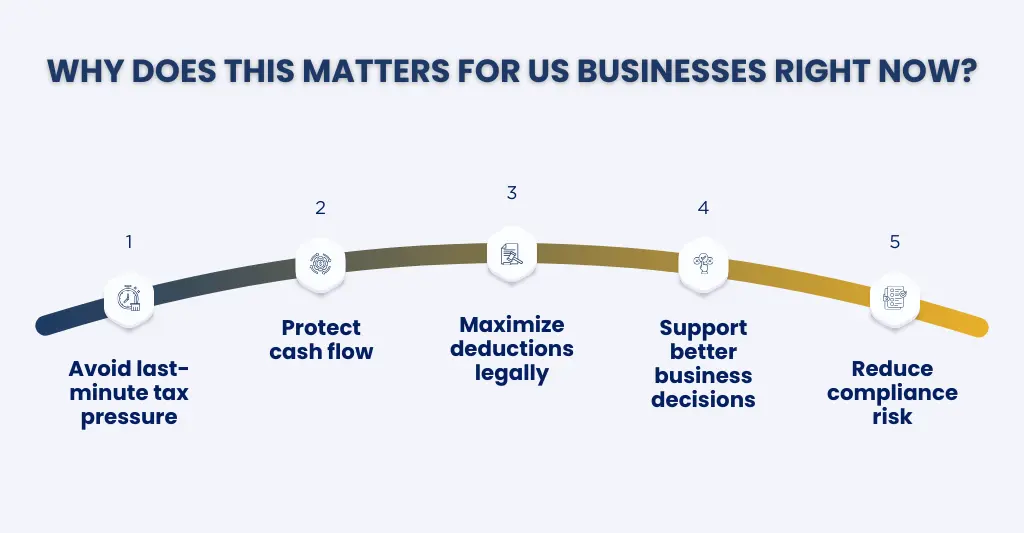
US businesses cannot afford to handle taxes as a once-a-year duty as tax season draws near. Early tax preparation is more crucial than ever because of changes to income levels, deductions, and planning opportunities for 2026.
Here’s why this matters right now:
- Avoid last-minute tax pressure: Don’t wait till the last moment of deadline day. As it often gives mental pressure and you tend to make mistakes and miss deductions. Businesses can maintain control by continuously preparing their taxes.
- Protect cash flow: Being aware of your tax situation in advance makes it easier to be prepared for expected tax payments and prevents unforeseen cash shortages.
- Maximize deductions legally: Make sure you claim the most important deductions in 2026 with proper strategic planning throughout the year. Not just during tax filing season.
- Support better business decisions: Before deadlines arrive, accurate tax preparation gives clarity on earnings, costs, and expansion strategies.
- Reduce compliance risk: When submitting federal forms, being proactive reduces the likelihood of mistakes, fines, or surprises.
Conclusion
Understanding the connection between income tax brackets, deductions, and tax planning is crucial for US firms in 2026. Being in a higher tax bracket always doesn’t mean you need to pay more tax on all of your income. Instead, it depends on how well you manage time, cash flow, and deductions.
Proactive tax planning can help businesses lower taxable revenue, prevent surprises, and make better financial decisions all year long as tax season draws near. You have greater control over taxes, cash flow, and long-term business growth in 2026 and beyond if you are consistent and accurate with your tax planning.
2026 Tax Brackets Are Already Shifting — Is Your Business Ready? Don’t wait until filing season to find out you missed key deductions. Corient’s US tax experts help you plan ahead, save more, and avoid costly surprises. Start My 2026 Tax Strategy Today.
FAQs: Frequently Asked Questions
Will tax brackets increase in 2026?
The IRS modifies income criteria annually to account for inflation, which may have an impact on the amount of income that falls into each bracket, but the tax rates remain unchanged.
Will I pay more tax on all of my income if I move into a higher tax bracket?
No. The higher rate of taxation is only applied to income that surpasses the lower bracket threshold.
Do higher tax brackets make tax deductions more valuable?
Sure. Higher tax brackets result in larger tax savings per dollar deducted because deductions lower income taxed at your marginal rate.
Which deductions should US companies prioritize in 2026?
Timing revenue and expenses, asset depreciation, retirement contributions, and business expenses are common themes.