How to Calculate Your Taxable Income? Step-by-Step Guide

Table of Contents

Understanding how your taxable income is calculated is an important aspect of money management in the United States. When you understand how the IRS calculates your overall earnings to the ultimate “taxable income” figure, tax season becomes less stressful and you are less likely to overpay or make mistakes on your return.

The good news is that U.S. tax rules are well-organized. First, you add up all your income from different sources. The Adjusted Gross Income (AGI) is calculated by subtracting certain permissible adjustments. After that, you subtract either the standard deduction or your itemized deductions. The amount remaining is your taxable income, which the IRS uses to calculate your tax bill.

In this guide, we will understand each of these steps in simple language, using real-world numbers like Alex’s example to show you exactly how the calculation works.

What is Taxable Income?

Let us begin by discussing the definition of taxable income. For federal tax reasons, taxable income begins with all income earned during the year, unless it is specifically tax free. Taxable income can include both earned (such as earnings and salaries) and unearned (such as investment income or gains from property sales).

Your taxable income is the difference between your gross income and the deductions you are qualified for. It is used to calculate your tax liability and marginal tax rate, thus you must have this information when filing your income tax return.

Revenues

For U.S. taxpayers, revenue (or gross income) includes almost all income you receive unless specifically excluded by law.
According to the IRS, gross income includes:

For Individuals:

  • W-2 wages and salaries
  • Self-employment income (Schedule C)
  • Freelance or gig income (1099-NEC / 1099-K)
  • Rental income
  • Interest and dividends
  • Capital gains (sale of stocks, property, crypto)
  • Business profits
  • Retirement distributions (IRA/401(k))
  • Unemployment compensation

For Businesses:

  • Sales revenue
  • Service income
  • Interest income
  • Commission income
  • Investment gains

Business Deductions

If you are self-employed or own a business, you can lower your taxable income by deducting usual and necessary business costs. According to US tax law, deductible company expenses must be:

  • Ordinary (common in your industry)
  • Necessary (helpful and appropriate for your business)

Common business deductions include:

  • Office rent
  • Software subscriptions
  • Payroll expenses
  • Contractor payments
  • Advertising and marketing
  • Business travel
  • Home office deduction
  • Depreciation of equipment

Personal Deductions (U.S. System)

Individuals can lower their taxable income further by claiming personal tax deductions after taking into account business deductions.
In the United States, taxpayers can choose between:

Standard Deduction:

  • A fixed amount set annually by the IRS.
  • For example (2025 estimates, subject to annual IRS updates):
  • Single filer
  • Married Filing Jointly
  • Head of Household

The standard deduction reduces your adjusted gross income automatically.

Itemized Deductions

Instead of the standard deduction, you can itemize if your deductible expenses are higher.
Common itemized deductions include:

  • Mortgage interest
  • State and local taxes (SALT deduction limit applies)
  • Charitable contributions
  • Medical expenses (above AGI threshold)
  • Casualty and theft losses
  • You claim whichever method gives you a lower taxable income.

Common Mistakes When Identifying Taxable Income

Understanding taxable income is straightforward, until minor misunderstandings result in costly IRS letters. Many US taxpayers commit some avoidable mistakes, which leads to penalties, interest charges, or even Internal Revenue Service audits.
Here are the most common mistakes to avoid:

1.Mixing Up Taxable and Exempt Income:

U.S. tax law, but many taxpayers assume it is.
Examples of taxable income:

  • Wages and salaries
  • Freelance income
  • Rental income
  • Interest from bank accounts
  • Dividends
  • Capital gains

Examples of generally non-taxable (or partially exempt) income:

  • Certain life insurance proceeds
  • Qualified Roth IRA distributions
  • Gifts received
  • Child support payments

The error occurs when people assume something is exempt without examining the IRS guidelines. Municipal bond interest, for example, may be free from federal taxes but remain subject to state taxes.

2.Thinking Some Income Doesn’t Need to Be Reported:

A very common misconception is:

A very common misconception is:
“If I didn’t receive a 1099 or W-2, I don’t have to report it.”

This is incorrect.
The IRS requires you to report all income, even if:

  • You weren’t issued a tax form
  • It was paid in cash
  • It was under $600
  • It came from a foreign source

The absence of a form does not mean that the income is hidden. Unreported revenue is one of the most common audit triggers, especially with contemporary reporting systems and third-party data matching.

3.Forgetting About Side Income or Interest:

In today’s economy, many people earn income from:

  • Freelancing or consulting
  • Online sales (Amazon, Etsy, eBay)
  • Rental platforms like Airbnb
  • Crypto trading
  • Dividend-paying investments
  • Bank interest

4.Assuming All Income Is Tax-Free:

Some taxpayers assume certain income types are automatically tax-free, such as:

  • Social Security benefits
  • Retirement withdrawals
  • Gifts from family
  • Inherited property

However, many of these are only partially taxable depending on overall income.

How to Calculate Taxable Income: Step-by-Step

Understanding how taxable income is calculated helps you avoid overpaying taxes and receiving unpleasant surprises from the Internal Revenue Service.
Let us take a thorough look at the entire process.

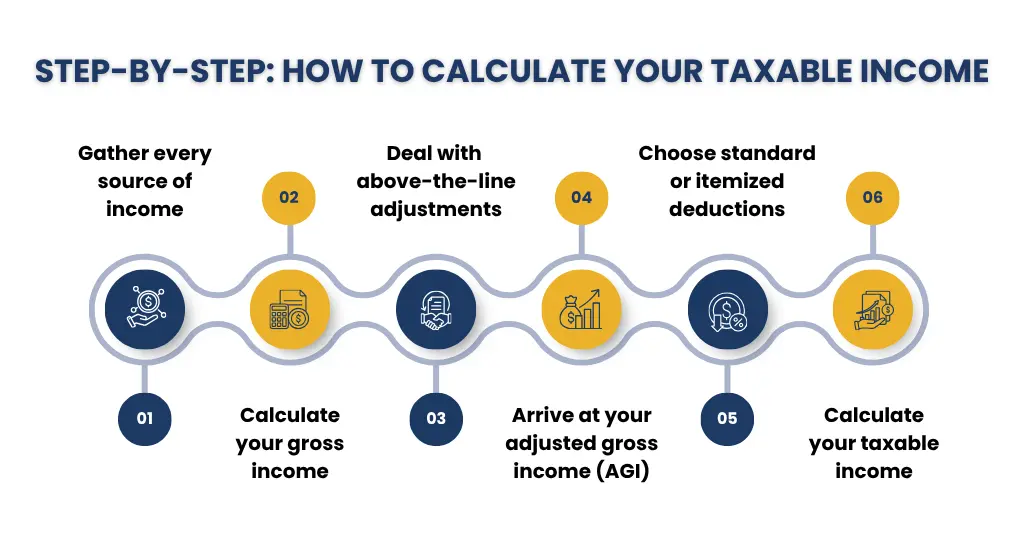
1.Add up all your income:

The first step is to gather every source of income you earned during the year.
This includes:

  • W-2 wages from your employer
  • Freelance or gig income (1099-NEC / 1099-K)
  • Business profits (Schedule C)
  • Rental income
  • Interest from bank accounts (1099-INT)
  • Dividends from investments (1099-DIV)
  • Capital gains from selling stocks or property
  • Retirement distributions
  • Taxable portion of Social Security

Important: Even if you do not receive a tax form, your income must still be declared.
At this point, you are just determining your total income.

2.Calculate Your Gross Income

Now add together all taxable income sources.

For Example:

  • Salary: $85,000
  • Freelance income: $12,000
  • Interest income: $1,000

Your Gross Income = $98,000

This is the complete income prior to any deductions or adjustments.

Business expenses are deducted from business owners’ personal income before it is calculated.

3.Adjust income to save on tax

Next, subtract any “above-the-line” deductions. These are known as adjustments to income and are reported on Schedule 1.
These lower your income before standard or detailed deductions are applied.

These lower your income before standard or detailed deductions are applied.

Common adjustments include:

  • Traditional IRA contributions
  • HSA contributions
  • Self-employed health insurance
  • Student loan interest
  • SEP-IRA contributions

4.Pick the deduction that saves you more

After calculating AGI, you must choose between:

  1. Standard Deduction – A fixed amount based on filing status
  2. Itemized Deductions – Specific expenses listed on Schedule A

Itemized deductions may include:

  • Mortgage interest
  • State and local taxes (SALT, capped limit applies)
  • Charitable donations
  • Medical expenses exceeding AGI threshold

You cannot take both. You choose whichever lowers your taxable income more.

5.Subtract deductions from your AGI

Now calculate your Taxable Income:

AGI – Standard/Itemized Deduction = Taxable Income

For Example:

AGI: $92,000
Standard Deduction: $14,600
Taxable Income = $77,400

This is the number used to calculate your federal tax.

6.Apply tax brackets and credits (after tax is calculated)

The U.S. tax system is progressive. That means different portions of your income are taxed at different rates.

You are not taxed at one flat rate.

Example (simplified concept):

  • First portion taxed at 10%
  • Next portion taxed at 12%
  • Remaining portion taxed at higher bracket

After calculating your tax based on brackets, you subtract tax credits.

Important difference:

  • Deductions reduce taxable income
  • Credits reduce actual tax owed dollar-for-dollar

Common credits include:

  • Child Tax Credit
  • Earned Income Tax Credit (EITC)
  • Education credits
  • Clean energy credits

Once you’ve got your taxable income, the next step is figuring out your tax using tax brackets. Don’t worry, it’s simpler than it seems! Want to learn how the brackets work and which rates apply to you? Check out our guide on Understanding U.S. Tax Brackets.

Ways to Reduce Income Tax

Reducing your income tax legitimately does not imply hiding income; rather, it entails strategic planning within the Internal Revenue Service’s guidelines. The US tax structure promotes clever saving, investment, and timing decisions. Here are several simple, efficient solutions for individuals and business owners to reduce taxable income.

Simple Ways to Cut Down Your Taxable Income:

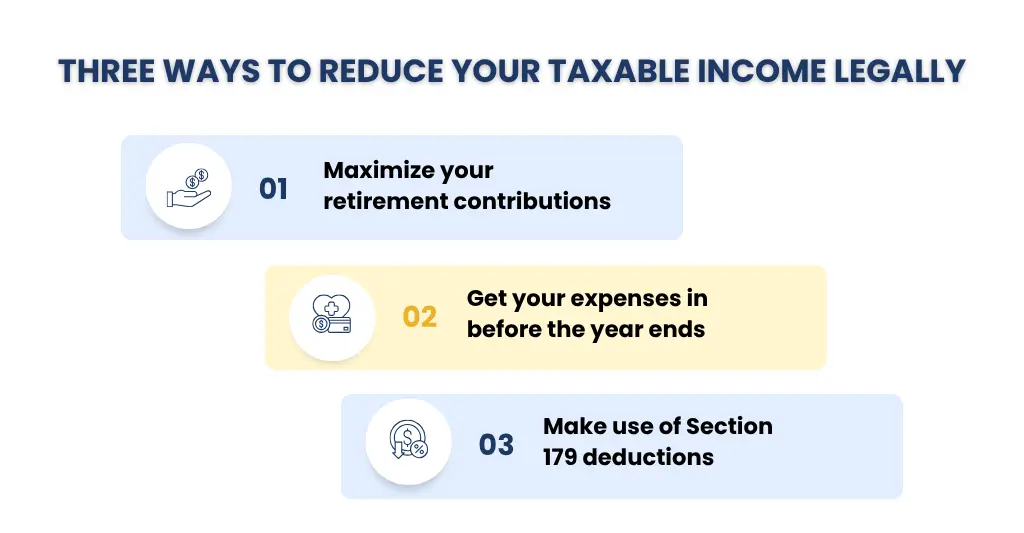
Save for Retirement: Contributing to a retirement account is one of the most effective tax-saving methods.

How it helps:

Contributions to certain retirement accounts reduce your taxable income for the year

Common tax-advantaged accounts:

  • Traditional IRA
  • 401(k)
  • SEP-IRA (for self-employed individuals)
  • SIMPLE IRA

Contributing $10,000 to a Traditional 401(k) can reduce your taxable income from $100,000 to $90,000 (subject to eligibility and limits).


Additional benefit:

  • Investments grow tax-deferred until withdrawn.
  • Self-employed folks can contribute considerably more through SEP-IRA plans.
  • This technique cuts current taxes while increasing long-term wealth.

Purchase Assets (Business Owners Strategy):

If you own a business, purchasing eligible business assets before the end of the year might reduce your taxable income. Section 179 and bonus depreciation allow businesses to deduct the cost of some equipment, cars, and technology in the same year of purchase, subject to limits.

Examples:

  • Computers and software
  • Office equipment
  • Machinery
  • Business vehicles (with rules and caps)

Instead of extending the deduction over several years, you can deduct a big part right now, lowering your current taxable income.

Accelerate Expenses and Defer Income:

This is a timing strategy often used by business owners and self-employed individuals.

Accelerating expenses means:

  • Paying deductible expenses before December 31
  • Prepaying rent or subscriptions
  • Making charitable contributions before year-end
  • Paying state taxes early (where applicable)

Deferring income means:

  • Delaying invoicing until January
  • Postponing bonus payments
  • Deferring certain business receipts

Quick Examples: Taxable vs Nontaxable Income

Income TypeTaxableNotes
Wages & Salary (W-2)YesFully taxable at federal level
Freelance / 1099 IncomeYesMust report even under $600
Business ProfitYesAfter deducting expenses
Bank Interest (1099-INT)YesEven small amounts are taxable
DividendsYesQualified dividends may get lower rates
Capital GainsYesShort-term taxed as ordinary income
Rental IncomeYesAfter allowable expenses
Municipal Bond InterestUsually No (Federal)May be taxable at state level
Life Insurance PayoutNo (generally)If received due to death
Gifts ReceivedNoDonor may have reporting obligation
Child SupportNoNot considered taxable income

If Sarah makes $85,000 in salary and $1,200 in bank interest, both are completely taxable and must be declared on her income tax return. Even if the interest is low, the IRS demands reporting.

Consider John, who receives a $50,000 life insurance payout after a family member dies. That money is often not taxable since life insurance death benefits are excluded from gross income.

If Maria sells equities for a $5,000 profit, the capital gain is taxable. However, if she receives a $10,000 present from her parents, she is not required to pay taxes on the gift; the sender is responsible for any reporting requirements.

Similarly, municipal bond interest is usually exempt from federal taxation, but it may be taxable at the state level depending on where you live.

How Business Income Tax Affects Your Taxable Income?

In the United States, business income tax has a direct impact on your taxable income, which is the percentage of your income that is taxed after accounting for all applicable deductions, exemptions, and adjustments. Understanding how this works is essential for every size and type of organizations when planning tax responsibilities and minimizing liabilities.

Taxable Income Is Based on Net Business Profit:

Your business’s taxable income is more than just the entire amount of money you bring in. Instead, it begins with gross income, and then subtracts allowable business expenses. What remains is your net profit, which is used to calculate your taxable income. Wages, rent, utilities, advertising, and other business-related costs are all common deductible expenses.

Formula:
Taxable Income = Gross Revenue − Deductible Business Expenses

For example, a consulting business with $200,000 in revenue and $50,000 in deductible costs would have $150,000 in taxable income, the amount subject to federal (and possibly state) tax.

Your Business Structure Determines How Taxable Income Is Treated

The way business income affects taxable income differs based on your business structure:

  • Sole Proprietorships & Single-Member LLCs: Business earnings are recorded directly on the owner’s personal tax return (Form 1040). The net profit is carried through and included in the owner’s taxable income.
  • Partnerships & S-Corporations: Partnerships and S-Corporations do not pay federal tax themselves. Instead, gains (or losses) are distributed to owners and reported on their individual returns using a Schedule K-1. The owner’s share of income raises their taxable income.
  • C-Corporations: C-corporations are taxed individually at the corporate level. It computes taxable income after all deductions and then applies the corporate income tax (usually a 21% federal rate) to that amount.

Deductions and Credits Lower Taxable Income:

Deductions (such as usual and necessary business expenses) reduce your taxable income, resulting in a smaller tax bill. Additional tax breaks, such as the Qualified Business Income (QBI) deduction, may allow pass-through entities and sole proprietors to deduct up to 20% of qualified business income, significantly lowering taxable income for eligible owners.

Net Operating Losses (NOLs) Can Affect Future Taxable Income:

If your business expenses exceed your annual income, you may have a Net Operating Loss (NOL). An NOL is frequently used to offset taxable income in subsequent years, lowering future tax liabilities. This carry-forward can be an effective strategy for balancing tax burdens between profitable and unproductive periods.

Federal, State, and Local Impacts:

While federal taxable income is the basic basis for business taxation, several states levy their own income tax on firms or individual owners of pass-through corporations. This means that taxable income may be significant at various levels of government, influencing total tax liability.

How Sales and Use Tax Impacts Your Taxable Income

Sales and use tax does not immediately increase your federal taxable income, but it can have a major impact on your business revenue, deductible expenses, and overall profit, all of which contribute to your taxable income.

Let’s break it down clearly using US tax standards.

  • Sales Tax You Collect Is Not Your Income: When you collect sales tax from customers (like $80 on a $1,000 sale), it’s not part of your income. It’s money you collect on behalf of the state.
  • Sales Tax on Business Purchases Might Be Deductible: If you pay sales tax on supplies or equipment, it could be deductible—helping you lower your taxable income.
  • Use Tax Could Affect Your Costs: If you buy something from another state with no sales tax, you might owe use tax, which can lower your taxable income.
  • Watch Out for Sales Tax Errors: Mixing up sales tax with income or forgetting to pay it can lead to mistakes that cost you.
  • State Taxes Matter Too: While sales tax doesn’t affect federal taxes, it can impact state tax filings and compliance costs—but these can often be deducted.

How E2E Accounting Provides Tax Help to Avoid These Mistakes?

E2E Accounting assists U.S. firms in avoiding frequent tax mistakes by implementing a structured, accurate, and compliance-focused financial framework behind their operations. Many errors, such as counting paid sales tax as income, missing deductible expenses, misclassifying revenue from platforms like Amazon or Shopify, or failing to manage multi-state nexus requirements, are the result of disorganized bookkeeping rather than purposeful negligence. E2E guarantees that sales tax is correctly recorded as a liability, revenue is reconciled, and all routine and necessary business expenses are recorded to legally minimize taxable income. The team monitors state-level sales thresholds to identify nexus exposure, assists with accurate sales tax reporting, and maintains audit-ready paperwork to reduce penalties and compliance risks.

In addition to compliance, E2E provides proactive tax planning, projected tax calculations, entity structure recommendations, and cash flow projections to help firms manage their tax position proactively rather than simply filing forms. E2E Accounting assists business owners in protecting earnings and avoiding overpayment of taxes by keeping books clean, deductions optimal, and reporting correct.

Need help with your taxable income calculation or want to make sure you’re claiming every deduction?Contact us today to schedule a free consultation and get expert advice on reducing your tax liabilities!

FAQs: Frequently Asked Questions

How do I calculate my taxable income?

To calculate your taxable income, first add up all your taxable income sources (salary, business income, interest, rental income, etc.) to get your gross income. Then, remove any adjustments (such as IRA contributions or student loan interest) to get your adjusted gross income (AGI). Finally, deduct the standard deduction or your itemized deductions. The amount remaining is your taxable income, which is used to determine your federal tax burden.

What deductions reduce taxable income the most?

The standard deduction, retirement contributions (such as Traditional IRA or 401(k) contributions), self-employed company expenditures, mortgage interest, and state and local taxes (up to the $10,000 SALT limit) are the most common deductions used to lower taxable income. For business owners, reasonable running expenses such as rent, payroll, software, and equipment can drastically reduce taxable profit. Choosing the bigger benefit of the standard deduction over itemized deductions also makes a significant difference in lowering overall taxable income.

How much income is taxable?

The majority of income in the United States is taxable unless specifically exempt by law. This comprises salaries, corporate profits, interest, rental income, and retirement distributions. Certain types of income, such as qualified Roth IRA withdrawals, donations, child support, and some municipal bond interest, are normally tax-free. The amount of income that is taxed is determined by your total earnings, filing status, adjustments, and deductions. Your taxable income is the amount left over after removing allowed deductions from your Adjusted Gross Income (AGI).

Do bonuses and side income count as taxable income?

Yes. In the United States, bonuses and side income are entirely taxable. Employer bonuses are considered supplemental wages and are subject to federal income, Social Security, and Medicare taxes. Side income, such as freelancing, consulting, gig work, or internet sales, must be declared and is usually liable to both income tax and, if self-employed, self-employment tax. Even if you do not receive a tax document (such as a 1099), you must still report your income.

Can mistakes in taxable income calculation cause IRS problems?

Yes. Errors in calculating taxable income may result in IRS letters, penalties, interest costs, or audits. Common mistakes that might cause problems include underreporting income, claiming inappropriate deductions, or failing to record side income. Even minor mistakes can result in higher tax and fines. That is why precise reporting and correct documentation are critical when filing your tax return.

Is investment income included in taxable income?

Yes, the vast majority of investment income is taxable. This includes interest, dividends, capital gains from selling stocks or real estate, and some mutual fund payouts. Certain types of investment income, such eligible dividends and long-term capital gains, may be taxed at a lower rate. Certain types, such as municipal bond interest, are usually free from federal income tax.

What are the best income tax preparation software services ?

TurboTax, H&R Block, TaxAct, TaxSlayer, and FreeTaxUSA are among the best US tax preparation services.
Simple returns are best handled using DIY software, however complex scenarios (company income, rentals, investments) may necessitate the services of a CPA or tax specialist.

What is the provision for income tax?

The provision for income tax is the expected amount set aside in a company’s financial statements to cover income taxes owed for a given period. It is shown as an expense on the income statement and a liability on the balance sheet until the actual tax payment is made. This guarantees that the corporation reflects the relevant tax expense within the same period in which the income was produced.

Conclusion :

Understanding how your taxable income gets crunched is pretty darn important whether you’re an individual or a business owner – you need to make sure you’re not writing a fat check to the IRS every year unnecessarily. From figuring out your gross income all the way to claiming the right deductions, the little details add up and can make a huge difference in your tax bill. By keeping on top of the rules and dodging common pitfalls, you can finesse your tax situation and hold onto more of your hard-earned cash.

If you want to be 100% sure you’re getting your taxable income right and not leaving yourself open to unwelcome tax surprises, then our team at E2E Accounting is here to lend a hand. We take the mystery out of everything from deducting business expenses through to ensuring you’re on top of multi-state sales tax compliance.

Share On:

e2e-accounting-logo

E2E Accounting Team

The E2E Accounting team combines expert accountants, legal specialists, and industry advisors to provide valuable insights into finance and compliance. With hands-on experience, we create content that informs, educates, and empowers business owners. From financial strategies to legal updates, our content serves as a reliable guide, ensuring accuracy, clarity, and a deep understanding of business challenges.

Contact Us