

Running a business or making a living that spans across MultiState Tax opens up loads of exciting new opportunities – but also comes with some major tax headaches. State tax obligations – let’s just say they’re complicated. Even the most seasoned business owner can still trip up and face a costly bill. Messing up nexus triggers or getting your tax apportionment wrong can land you with a hefty back tax bill and a nasty batch of penalties, interest and all the rest. The more you expand across state lines, the more quickly these mistakes will mount up and turn into a right old nightmare, all the more expensive because they turn into serious legal trouble.
The tax landscape has been turned on its head over the last ten years, mainly because of the rise of remote work, e-commerce and all those distributed teams you see everywhere. Loads of businesses now operate in loads of different states but still go about their tax duties like they only do business in one place. State tax rules are all over the shop – and the differences – especially in corporate income taxes and sales tax, can vary vastly. Some states don’t even tax income while others have tax rates that can break you. Without proper expert advice or a solid compliance plan in place your business is basically flying blind through a minefield. The states are now all swapping tax data and crunching numbers to find non-compliants and the penalties can be serious.
Real World Example
An e-commerce company in Texas sends out packages all over the US. 2018 saw the Wayfair ruling come in, and before long California, New York and Illinois had all started enforcing their own rules around how much in sales you’d have to make before you’re considered being based in their state (usually it’s $100,000 in sales or 200 transactions per year).
See our Amazon FBA nexus guide for NY sellers The finance team running things at this particular company didn’t know any of this, and for three whole years they just kept filing taxes in Texas – no problem. Then California’s Franchise Tax Board spotted the company doing a routine check-up on all the businesses it was supposed to be keeping tabs on and suddenly that e-commerce business found itself staring down the barrel of a $180,000 bill for back sales taxes, interest and late filing penalties. It’s a painful lesson that could have been avoided with a bit of timely monitoring of the various state tax requirements and getting the right paperwork filed in the right places.
It turns out, there are loads of businesses out there who’ve had to learn the hard way how disastrous it can be to not get a proper handle on tax preparation services and the various rules that apply in each state. That’s why getting a solid grip on all these different state-by-state obligations isn’t some nice-to-have, it’s a must-have for any business that’s worth its salt.
In this guide, we’re going to look at the top 7 mistakes people make when it comes to dealing with MultiState Taxes – and more importantly, we’re going to show you how getting ahead of the game and being proactive about all the various tax compliance issues can save you a whole lot of money in the long run.
7 Multi State Tax Mistakes to Avoid
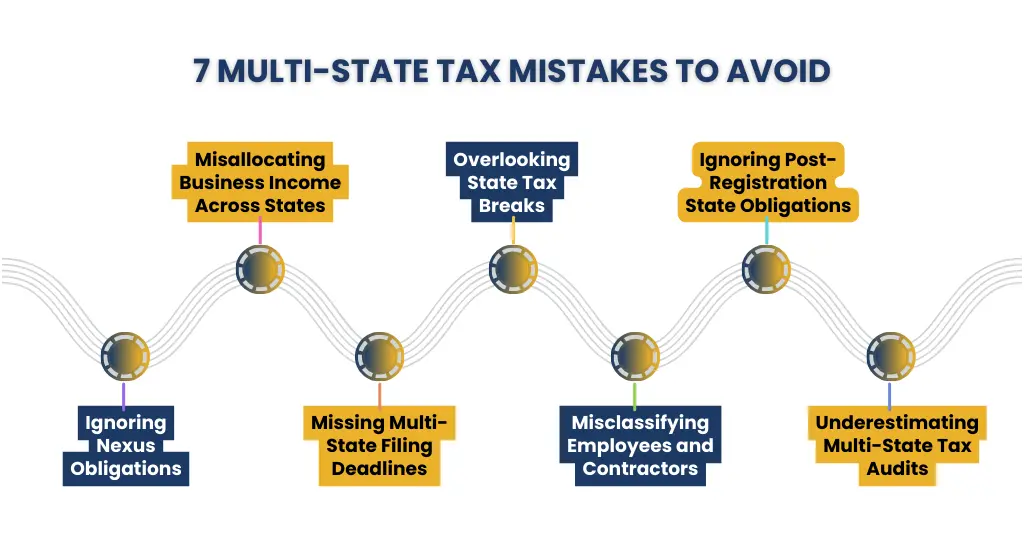
Mistake #1: Ignoring Nexus Obligations – The Hidden Tax Trap
Nexus is the line in the sand that determines whether your business has a connection to a state that gets taxed. A lot of businesses are caught out because they unknowingly tick the nexus box through having a handful of remote workers, or storing inventory in a warehouse somewhere, or even just having one sales rep zip across a state border.
The South Dakota v. Wayfair court case was a big deal for business owners. It set off a chain reaction of states introducing economic nexus laws that mean over 40 states now slap sales tax obligations on businesses based on how much they make or how many transactions they have – regardless of whether they’ve got a physical presence or not. Ignoring nexus exposure is probably the most common and most costly mistake that businesses make when it comes to MultiState Tax.
How to avoid it:
Every year, get a grip on where you’ve got nexus obligations in each state. Make a map of all the places where you’ve got employees, property or sales activity going on. Being proactive about multistate tax compliance starts with knowing exactly where you’ve got a tax bill to pay.
Mistake #2: When You Get Your Business Income Splits Wrong Across Multiple States
When you’ve got income coming in from more than one state, it needs to be apportioned out – divided up based on the right formula. Most states just use a simple sales apportionment formula, but a few still use a more complex three-factor formula that takes into account payroll, property, and sales. Get that wrong and you can end up getting taxed twice, or not enough.
Missing the mark on apportionment can cause big problems because the mistakes just add up over time. If a business gets its apportionment wrong three years in a row, they can face a whopping bill for back taxes.
How to avoid it:
Work with someone who really knows multistate tax – a specialist who can tell you which apportionment method is right for each state. And make sure you’re keeping good records – including where your revenue is coming from, how much you’re paying your employees by location, and what your properties are worth.
Mistake #3: Falling Behind on Filing Deadlines Across Multiple States
Every state has its own tax deadlines, extension rules, and payment plans – and that means a business with stuff to file in 10 different places has 10 separate schedules to keep track of. Missing just one deadline can land you with a penalty of anywhere from 5% to 25% of the tax you owe – and to make matters worse, interest gets tacked on daily, too.
Getting on top of MultiState Tax Returns is a matter of staying organised when it comes to deadlines. Unlike federal returns, state penalties are not often waived, even with a good reason – and some states are really keen on chasing up payments.
How to avoid it:
Start by creating a master calendar that keeps all the state deadlines in one place. If you have the budget, look into investing in some tax compliance software or get yourself a firm that knows their stuff on multistate tax compliance – that way you can set up automatic reminders and get the job done for you.
The #4 Tax Slip-Up: Failing to Claim State-Specific Tax Breaks
While tax season tends to focus on paying up, too many business owners are missing out on the chance to save serious cash by ignoring tax credits – their state has to offer. You’d be surprised how many different types of credits and incentives there are. For starters, there are research and development credits, job creation rewards, investment tax breaks and even green energy perks. But the thing is, these vary from state to state and just as often as not, no one ends up claiming them.
But let’s get real about what good tax planning is all about: it’s not just about fulfilling your obligations – it’s about spotting savings. Take a company operating in a state like Georgia, Texas or North Carolina for example. Chances are they qualify for tens of thousands of dollars in credits every year.
How to avoid it:
Don’t just treat tax season as an afterthought; actively work savings into your annual tax planning. Make time to review what state credits and incentives you’re qualified for; keep track of qualifying activities throughout the year so you’re in a position to claim everything you’re entitled to at tax time. Calculate taxable income accurately with our guide.
Mistake #5: Getting Employees and Contractors Mixed Up
Worker classification is a nightmare in multistate situations. The rules around who’s an employee and who’s an independent contractor can be totally different from state to state – and it’s easy to get it wrong. So if some states call a contractor an employee then you’re suddenly on the hook for their benefits, taxes and any back pay they might be owed.
Some states like California have rules that are particularly tough on businesses – they’ll make you prove that a worker is genuinely their own boss before they’d even consider them a contractor. And don’t even get started on how this all adds up with states that have rules of their own – it’s a whole mess. If you’ve got employees working in different states, you’re not just dealing with the rules where they happen to be working right now – each state gets to decide for themselves what they think is the right answer.
How to avoid it:
Take a good hard look at how you’re classifying workers in each state and make sure your MultiState Tax strategy is taking into account the different taxes and withholding rules that each state has – it’s not going to be fun.
Mistake #6: Overlooking State Obligations When You’ve Registered a Business
A lot of businesses get themselves into trouble by registering to operate in a state, maybe to open a bank account or sign a lease, but then they forget all about the tax return obligation they created – even if they made zero in that state. The thing is states tend to see registration as a trigger for annual reporting requirements, no matter how much money you made.
This mistake is super common with startups and businesses that grow super fast – they get so busy that they let unfiled returns pile up, and then when the state finally catches wind of it they’re looking at years & years of penalties and interest on top of the original tax they owe.
How to avoid it:
Keep a list of every state your business is registered in. Your multi state tax filing checklist should include EVERY state, even if you only made a tiny bit of money there – and if you no longer need a registration, sort out formally withdrawing to stop any future obligations.
Before you file — get our FREE guide: learn how to file multi-state returns step-by-step
Mistake #7: Underestimating Just How Scary Multi-State Tax Audits Can Be
Lots of people think tax audits from states are rare or some kind of joke – that they’re a whole lot less rigorous than IRS audits. But trust us, this is a misconception. States are getting a lot more aggressive in going after revenue and a multi state tax audit can set off a whole chain reaction of reviews across lots of different jurisdictions – especially if the MTC (Multistate Tax Commission) is sharing information around.
One audit can completely unravel a whole year’s worth of filings. Poor documentation, inconsistent apportionment and missing returns all get picked apart big time under audit scrutiny.
How to avoid it:
Treat every state tax return like it will get audited. Keep your documentation super thorough for nexus determinations, apportionment calculations and tax credits. Being on top of your multi state tax compliance is your best defense against an audit.
Avoiding the Multi-State Tax Pitfalls: Quick Reference Guide
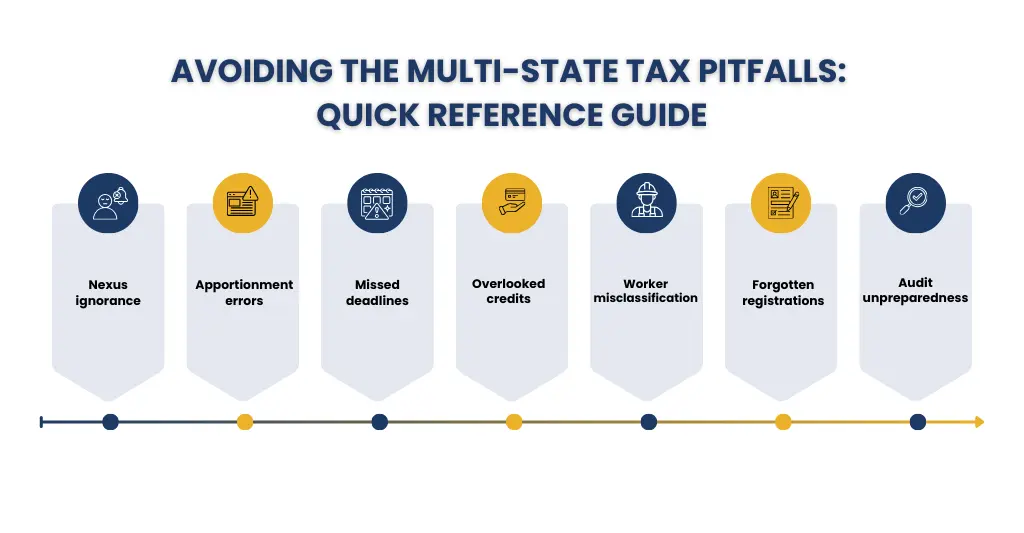
Here’s a rundown of the most common mistakes and what you should do to avoid them:
- Nexus ignorance – annual checks are a must, so make sure to review your nexus status across all active states each year
- Apportionment errors – if you’re not 100% sure of the rules, then work with a specialist to get them right
- Missed deadlines – a centralized calendar is your best friend when it comes to keeping track of these things
- Overlooked credits – make it a habit to review your credits and incentives at the end of each tax year
- Worker misclassification – this one’s a no-brainer – when you move into a new state, take the time to review the rules on worker classification
- Forgotten registrations – you don’t want to get caught with your pants down so keep a list of all the states you’re registered in and make sure to formally withdraw when you’re no longer active
- Audit unpreparedness – treat every audit like it’s a given, and keep records in order
Need help with MultiState Tax compliance? Contact our team of specialists today.
Our experts are ready to help you navigate complex state tax obligations with confidence.
FAQs: Frequently Asked Questions
Which states have an economic nexus for sales tax?
Over 40 states enforce economic nexus, typically $100,000 in sales or 200 transactions annually. Thresholds vary—e.g., California ($500k), New York ($500k + 100 transactions). Check each state’s dept of revenue for updates, especially for e-commerce sellers.
How do I apportion income across multiple states?
Most states use single-sales factor apportionment (income divided by sales in that state). Others apply three-factor formulas (sales, property, payroll). Use precise records of revenue sources and consult a specialist to prevent double taxation.
What are the penalties for missing multistate tax deadlines?
Penalties range from 5-25% of tax due per state, plus daily interest. States rarely waive them, unlike federal. Create a master calendar covering all filing schedules—monthly, quarterly, or annual.
Do I owe taxes in states where I’m registered but had no sales?
Yes, registration often triggers annual returns, even with zero income. File “zero returns” or formally withdraw to halt obligations and avoid escalating penalties over years.
Conclusion :
The truth is the more employees you’ve got, the more warehouses you lease and the more new states you sell to the more complicated multi-state tax is going to get.
The businesses that stay ahead of their exposure are those that treat compliance as an ongoing strategic priority — not a once-a-year scramble.
Whether you’re a sole proprietor with remote income, a growing e-commerce brand, or a multi-entity corporation, partnering with professionals who specialize in MultiState Tax is one of the smartest investments you can make. From accurate Multi State Tax Filing to forward-looking audit defense, the right team transforms compliance from a burden into a competitive advantage.
Don’t wait for a notice from a state revenue department to take action. Start with a comprehensive nexus review, build your compliance calendar, and make thorough tax preparation a non-negotiable part of your annual financial planning. The cost of prevention is always far less than the cost of correction.