
Tax season is finally upon us and April 15th is just around the corner. Whether you are tackling your business income tax for the first time, wrestling with the chaos of multi-state tax returns, or just trying to squeeze every last penny out of your refund — one thing is crystal clear: the more prepped you are before your appointment, the less you’ll be handing over to the taxman.
The good news? You don’t have to go it alone. Our expert Tax Preparation Services have been built on the same high standards used by the big players like the AARP Foundation Tax-Aide program and Jackson Hewitt. This free tax preparation checklist will make sure your appointment goes smoothly.
Read this thing carefully, save it to your phone, and bring it along to the appointment — trust us, you’ll be glad you did.
What Makes a Bigger Refund a Reality?
The most common reason people end up with smaller refunds — or end up owing money they weren’t counting on — is simply that they stumbled into their free tax preparation appointment without all the right documents ready to go. When you don’t have all the necessary info, you miss out on deductions and credits, and the whole process grinds to a halt.
When you come ready for your free tax preparation appointment, your tax pro can:
- Accurately figure your total taxable income from all sources
- Apply every single deduction and tax credit you qualify for
- File your return fast and get it right the first time
- Advise you on any multi-state tax return obligations you didn’t know about
- Hunt down sales and use tax liabilities if you run a business
- Make sure you’re all set with your IRS Identity Protection PIN (IP PIN) requirements
Pro Tip: According to the IRS, the average federal refund in the 2025 filing season was $3,453 — just think about what you could gain with proper preparation.
1.Personal Documents to Bring to Your Free Tax Preparation Appointment
Before heading to your appointment, you’re going to want to round up some important documents for yourself and every household member included on the return:
- A valid government-issued photo ID — driver’s license, state ID, or passport — is essential for every taxpayer
- Your Social Security Number or Individual Taxpayer ID Number (ITIN)
- Your spouse’s SSN or ITIN, and the same for any dependents — kids, elderly parents, etc.
- The birthdays of all household members — yourself, your spouse, your dependents
- Last year’s tax return, if you have it handy — helps catch any carryover deductions
- Your bank account and routing number for direct deposit — bring a voided check to save hassle
- If you’ve got an assigned IRS Identity Protection PIN, bring it along — it stops fraudsters from messing with your filing
- Any IRS correspondence or notices you received over the past year — better safe than sorry
Pro Tip: The IRS strongly advises setting up direct deposit — with proper free tax preparation, your refund can arrive in as little as 21 days, vs. 6–8 weeks for a paper check. Bring a voided check (not a deposit slip).
2.Income Documents — Getting Every Source of Taxable Income Right
One of the trickiest parts of free tax preparation is making sure you’re including all of your taxable income in your return. If you leave out just one 1099 or W-2, you can end up with IRS mismatch notices, delays, or even penalties.
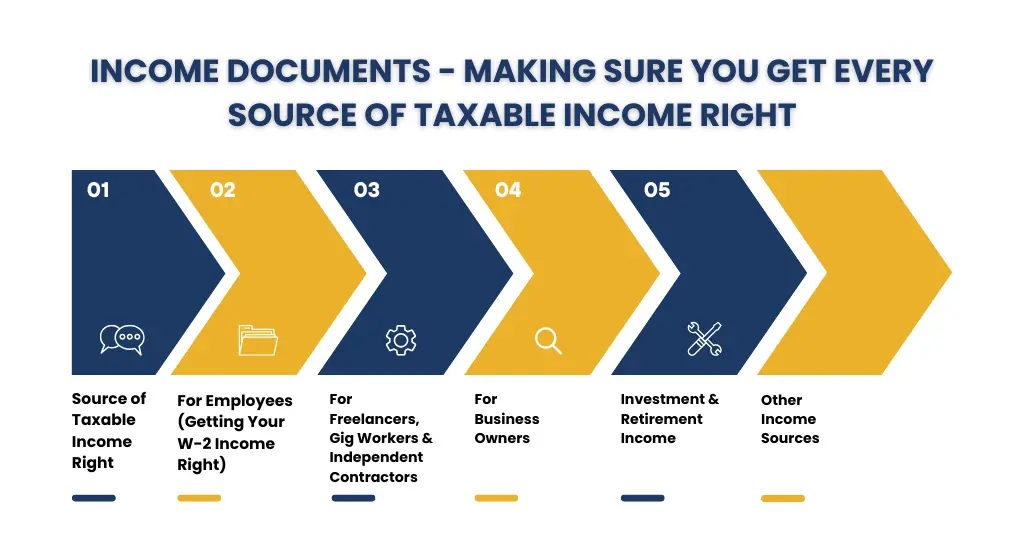
For Employees (Getting Your W-2 Income Right)
- A W-2 form from every single employer you worked for during the year
- If you worked multiple jobs, you’ll need a separate W-2 from each employer
- If you won more than $600 at a casino, bring a W-2G form
For Freelancers, Gig Workers and Contractors – Getting Your Head Around Tax Time
- Your 1099-NEC if you made over $600 from self-employment
- Your 1099-K if you get paid through PayPal, Venmo or Cash App (for instance, if you’re a raver who uses Venmo to split costs with mates)
- Your 1099-MISC for prizes, awards, rent & a whole bunch of miscellaneous income
- Keep a record of all the miles you drove for work – that’s a pretty big deduction, after all
- Keep all the receipts for business expenses – that means office supplies, tools, advertising, the lot
Business Owners – Tackling Business Income Tax
You’d think it’d be a doddle to get your business income tax return sorted, but it can be a right old nightmare – especially if you’re a sole-trader, an LLC or a partnership. But the good news is that solid records can make a world of difference and dramatically reduce your taxable income. So here are the things you need to get ready for tax prep:
- A profit and loss statement for the entire tax year
- All your business income records – that’s contracts, invoices and paperwork
- Business expense receipts, all organized by category
- Record of any sales tax you collected on goods or services sold
- Form K-1 if you’re a partner in a partnership, S-Corp or trust
- A record of any estimated tax payments (Form 1040-ES)
- Payroll records and a summary (W-3) if you have employees
Tax preparation link here
Investment & Retirement Income
- Your 1099-DIV if you earned dividend income from stocks or mutual funds
- Your 1099-INT if you earned interest income from a bank account or bonds
- Your 1099-B if you sold stocks, bonds or mutual funds
- Your 1099-R if you took a distribution from an IRA or 401(k)
- Form 5498 if you made IRA contributions during the year
- Your 1099-S if you sold a property
- Cryptocurrency – the IRS wants you to report on all digital asset transactions – that includes trading one cryptocurrency for another or selling an NFT
Other Income Sources
- Your 1099-G if you got a state tax refund or some sort of unemployment benefit
- SSA-1099 if you’re drawing Social Security or Railroad Retirement benefits
- Alimony income if you got divorced before the start of 2019
- Any income from abroad or foreign bank accounts – that may need a bit more paperwork
pro tip: 1099s and W-2s get sent to both you and the IRS. If your return doesn’t match theirs it’ll trigger a flag for them. Don’t guess, wait for all your forms to arrive before filing – don’t be a numpty
3.ACA Health Insurance & Healthcare Docs
One of the most often-overlooked parts of tax time is health insurance documents. According to HealthCare — if you bought coverage through the Health Insurance Marketplace (also known as Obamacare), you must file Form 8962 to reconcile your Premium Tax Credit, even if you didn’t receive any of that credit:
- Form 1095-A — The Health Insurance Marketplace Statement (usually arrives by mid-February if you had an Obamacare plan)
- Form 1095-B — Coverage details from your insurance company, Medicaid, or CHIP
- Form 1095-C — Your employer’s statement on health insurance coverage
- Form 8962 — The Premium Tax Credit reconciliation form (required if you used a marketplace plan)
- Proof of health insurance coverage for every month of the year
- Records of major out-of-pocket medical, dental, or vision expenses (deductible if they exceed 7.5% of your AGI)
Attention! If you had an ACA marketplace plan but can’t find your 1095-A, your tax return can’t be completed. Contact HealthCare.gov or your state’s exchange to track down a copy before your appointment.
April 15th is closer than you think — get our FREE guide: your complete tax season 2026 checklist for small businesses
4.Deductions and Credits That Can Put Money Back in Your Pocket
A lot of people leave real cash on the table because they don’t know about deductions that apply to their free tax preparation situation. A professional tax preparer will know exactly which ones you qualify for.
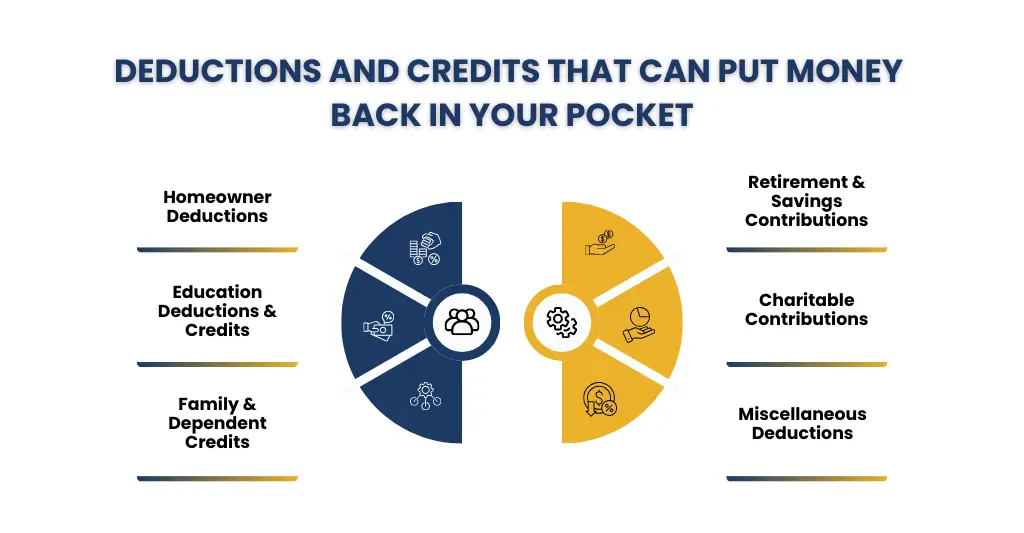
Homeowner Deductions
- Form 1098 from your mortgage company showing mortgage interest paid
- Records of mortgage insurance premiums (PMI payments)
- Proof of property tax payments — usually from your county or city
- Receipts for any points paid on a new mortgage or refinance
- Square footage of your home office vs. total home square footage (for home office deduction)
- Receipts for energy-saving upgrades: solar panels, heat pump, new windows, or EV charger — up to a 30% tax credit in 2025
Education Deductions & Credits
- Form 1098-T from your college proving qualified education expenses were paid
- Form 1098-E showing student loan interest paid
- Records of work-related education expenses if you’re military, a government worker, or self-employed
- School expense records for K-12 kids in your household (may be a state-specific deduction)
Family & Dependent Credits
- Details on childcare providers used (required for the Child & Dependent Care Credit)
- Total amount paid to each childcare provider during the year
- Adoption expense records — federal tax credit worth up to $17,280 in 2025
- IRS Letter 6419 if you received the Advance Child Tax Credit last year
Retirement & Savings Contributions
- Records of traditional IRA contributions (these reduce your taxable income)
- HSA (Health Savings Account) contribution statements — Form 5498-SA
- SEP-IRA or SIMPLE IRA records if you’re self-employed
Charitable Contributions
- Official receipts for cash donations (bank statements alone may not be sufficient)
- Non-cash donation records with fair market value estimates (clothing, furniture, electronics)
- Acknowledgment letter from the charity if you donated a vehicle
- Mileage log if you drove for a charitable organization
Miscellaneous Deductions
- Records of estimated tax payments made in 2025 (Form 1040-ES)
- Prior-year state income tax refund if it was taxable
- Gambling loss records if you itemize — just don’t forget to report your winnings too
- Union or professional dues records — may be deductible
- SSN of alimony recipient if your divorce was finalized before 2019
5.Multi-State Tax Returns — When Did You Work or Live In More Than One State?
Multi-state tax returns are usually the source of big headaches — and big bills — for a huge number of taxpayers. If you moved, started working for an out-of-state employer from home, or earned income in more than one place, chances are you’ll need to file multiple state tax returns. We recommend bringing along:
- All W-2s and 1099s showing income earned in each state
- Exact dates you lived or worked in each state during the year
- Any state tax already paid or withheld
- Last year’s state tax return (in case you need to carry over deductions or credits)
- Proof of address change if you moved to a new state — new lease, driver’s license date, voter registration
Pro Tip: Remote workers, pay attention. If you work for a company in one state but spent the year working from another, you could owe taxes in both states. Our team at E2E Accounting specializes in handling multi-state tax returns with precision.
Want to know more about: learn how to file multi-state returns step-by-step
6.Business Owners — The Lowdown on Sales and Use Tax
If you sell goods or taxable services, it’s vital you understand your sales and use tax obligations. A lot of small business owners are surprised to find they owe use tax on purchases that didn’t include sales tax. Bring the following:
- State sales tax collected throughout the year (monthly sales reports)
- Exemptions granted from tax-exempt customers
- Records of out-of-state purchases that didn’t have sales tax applied (use tax owed)
- Any sales tax returns already filed with the state
- Any state notices or assessments related to sales tax
7.Life Events That Throw a Wrench in Your Tax Situation
Major life events can really shake up your return during free tax preparation season. Flag all of these for your preparer:
- Got married or divorced — it’ll impact your filing status and you may need to update your name and SSN
- Had a baby — you’ll need a new SSN and may qualify for the Child Tax Credit
- Bought or sold a house — you’ll get a Form 1099-S if you sold; bring the closing statement if you bought
- Inherited cash or assets — there may be tax obligations involved
- Dealt with a federally declared disaster — have all FEMA paperwork ready
- Retired or began receiving pension or Social Security income
- Opened or closed a business during the year
- Filed for bankruptcy — it may affect what you owe in taxes
8.Getting the Most Out of Your Free Tax Prep Appointment – What to Ask Your Preparer
Being prepared really is key, so have these questions on your mind for the appointment:
- Am i in line for the Earned Income Tax Credit (EITC)? I’ve got a hunch my situation might make me eligible
- Itemising my deductions – is that the way to go or should I play it safe with the standard deduction (that’s $15,750 for singles or $31,500 for joint filers this year)
- Will chipping in to a Traditional IRA or health savings account by the deadline be worth it for me?
- Am I forgetting some key business income tax deductions I could be claiming?
- Do I need to worry about any sales tax I might have forgotten to pay?
- Worked in a second state this year? Could I be looking at multi state tax returns?
- What can I realistically do between now and December 31st to keep my tax bill from getting too out of hand?
What NOT to Do Before Your Free Tax Preparation Appointment
- Don’t bring receipts in a jumbled bag — sort them by category first so we can get started quickly
- Don’t guess at income figures — we need actual numbers to avoid IRS mismatches
- Don’t omit cash income, side gig income, or barter income — all income must be declared
- Don’t leave your 1095-A in the car — bring it or we can’t complete your return
- Don’t skip your cryptocurrency transactions — the IRS requires reporting of all digital assets
- Don’t wait until April 14th — rushing means missing key deductions
- Don’t throw away IRS or state tax letters — bring them to your appointment
Book Your Free Tax Preparation Consultation Today
Leave that refund on the table? Absolutely not. Our experienced team handles everything from simple W-2 returns to complex:
- Multi-state tax returns
- Business income tax filings
- Sales and use tax obligations
No hidden fees | Expert Preparers | Maximum Refund Guaranteed. Ready to get started? Explore our professional Tax Preparation Services and book your appointment today.
FAQs : Frequently Ask Question
What documents do I need for a tax preparation appointment?
At minimum, you’ll need a government-issued photo ID, your Social Security Number or ITIN, all W-2s and 1099s, last year’s tax return, and your bank routing number for direct deposit. Depending on your situation, you may also need health insurance forms (1095-A/B/C), business income records, and investment statements. Use the checklist above to make sure nothing gets left behind.
How early should I start preparing for tax season?
January, as most W-2s and 1099s are issued by the end of that month. The earlier you prepare, the more time your tax preparer has to identify every deduction and credit you qualify for — and the sooner your refund arrives.
What happens if I miss a 1099 or W-2 on my return?
The IRS receives copies of all your 1099s and W-2s. If your return doesn’t match their records, it triggers an automatic mismatch flag that can lead to notices, delays, or penalties. Always wait for every form to arrive before filing — never guess at income figures.
Do I have to report freelance income, PayPal payments, or cryptocurrency?
Yes to all three. Freelance income over $600 is reported on a 1099-NEC. Payments received through PayPal, Venmo, or Cash App for goods or services are reported on a 1099-K. Cryptocurrency is treated as property by the IRS — all transactions including crypto-to-crypto trades and NFT sales must be reported. Omitting any of these can result in penalties.
Do I need to file taxes in more than one state?
Possibly. If you moved during the year, worked remotely for an out-of-state employer, or earned income across multiple states, you may be required to file multi-state tax returns. Requirements vary by state, and some states can tax remote workers based on where the employer is located — not where you actually worked. A professional tax preparer can review your specific situation and ensure you’re compliant.
What is Form 1095-A and why does it matter?
Form 1095-A is the Health Insurance Marketplace Statement sent to anyone who had an Obamacare plan. It’s required to complete Form 8962, which reconciles any Premium Tax Credit you received during the year. Without it, your tax return simply cannot be finalized. If you can’t locate it, contact HealthCare.gov or your state exchange before your appointment.
Conclusion — Your Free Tax Preparation Checklist, Your Refund, Your Future
Free tax preparation is more than just saving a few bucks on filing fees — it’s about getting your money back accurately and on time, claiming every deduction you deserve, and making smart financial decisions that benefit you long-term. Whether you’ve got a simple W-2 return, a complex multi-state tax situation, business income tax questions, or sales and use tax worries — our team at E2E Accounting is here to help.
April 15th is waiting for no one. Bring this checklist along and we’ll take care of the rest.