
Online businesses move quickly, and so does money. Sales happen 24 hours a day, seven days a week, refunds occur promptly, and fees gradually reduce profitability. However, many eCommerce businesses continue to rely on accounting systems designed for offline operations. That gap is where troubles begin.
eCommerce CPA services close that gap. A specialized CPA understands how digital sales ecosystems operate and guarantees that your financials mirror reality. The end result is not simply compliance, but also transparency, control, and more informed growth decisions. In this blog, we will be learning about why your eCommerce business needs a special eCommerce CPA services.
What is an eCommerce CPA?
An eCommerce CPA is a Certified Public Accountant who focuses on handling the finances of online enterprises. eCommerce CPAs are different compared to regular CPAs. eCommerce CPA understands how digital sales platforms, payment processors, and online tax rules interact.
They handle complex issues like high-volume transactions, platform fees, refunds, inventory accounting, and multi-state sales tax. An eCommerce CPA does more than just file tax returns; they also give accurate financial reporting, assure compliance, and provide insights that enable online firms to enhance profitability and scale confidently.
How an eCommerce CPA Helps with Sales Tax Compliance?
Sales tax is one of the most difficult issues for eCommerce companies, especially when selling across numerous states. An eCommerce CPA assists your company in determining where it owes sales taxes and ensures that taxable and non-taxable sales are properly documented.
They organize sales data from all platforms, evaluate tax collected through payment systems, and ensure that your records meet state regulations. An eCommerce CPA eliminates the danger of errors, penalties, and last-minute compliance concerns by keeping clean, accurate sales tax records, providing confidence as your online business expands.
Streamlining Inventory and Cost of Goods Sold (COGS) with an eCommerce CPA
Inventory and COGS are critical components in evaluating an eCommerce business’s genuine profitability, yet they are frequently mismanaged or disregarded. An eCommerce CPA ensures that inventory is effectively tracked across sales channels, refunds, and restocking, allowing your books to represent the true value of your stock.
A CPA accurately computes COGS by taking into account product costs, shipping and handling, and any related fees. As your online business grows, you get a clear perspective of inventory movement and COGS. It also provides you with correct profit margins, improved pricing insights, and greater control over cash flow.
Why eCommerce CPAs Are Essential for Tax Planning and Deductions?
eCommerce companies confront particular tax problems that extend beyond submitting an annual report. Income is distributed across numerous platforms, expenses are split among tools, advertisements, logistics, and software, and scheduling variances might influence how profits are taxed. A CPA understands the complexity and works ahead of time to legally reduce tax liability.
An eCommerce CPA may assist you in claiming the correct eCommerce tax deduction without triggering IRS compliance issues by examining your business structure, precisely tracking deductible spending, and strategically scheduling income and expenses. This proactive approach not only lowers unexpected tax costs, but it also promotes long-term financial efficiency and growth.
Financial Forecasting and Profitability Insights from eCommerce CPAs
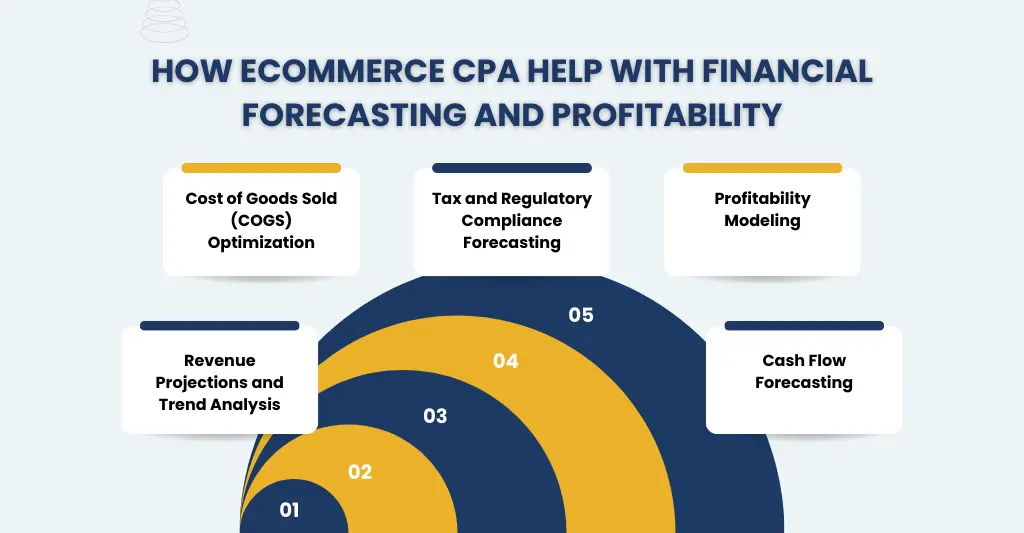
To be competitive, eCommerce businesses require more than just typical bookkeeping; they must also conduct accurate financial projections and profitability analyses. eCommerce CPAs (Certified Public Accountants) specialise in this field, providing essential insights into financial patterns and forecasts to help business owners make informed decisions.
Here’s how eCommerce CPA help with financial forecasting and profitability:
Revenue Projections and Trend Analysis: eCommerce CPAs predict future sales and revenue patterns based on historical data and market study. Based on the findings they assist in forecasting high and low performance by studying seasonality, customer behavior, and marketing ROI. This ensures that firms are prepared to successfully manage cash flow during slow months while profiting on high periods.
Cost of Goods Sold (COGS) Optimization: Understanding COGS is essential for profitability. CPAs monitor your inventory costs, shipping costs, and other direct expenses to ensure you are pricing your products accurately and identifying cost-saving opportunities. They will also guide you about managing supplier relationships and lowering overheads.
Tax and Regulatory Compliance Forecasting: eCommerce businesses sometimes confront difficult tax issues. CPAs anticipate possible tax liabilities based on revenue trends and changes in tax law, ensuring that firms are prepared and in compliance with tax laws. They can also forecast how tax reforms such as new sales tax rules will affect the bottom line.
Profitability Modeling: CPAs help to construct profitability models by assessing several business drivers such client acquisition costs, conversion rates, and average order values. They assist in optimizing pricing strategies and operational costs in order to maximize profit margins while maintaining quality and customer satisfaction.
Cash Flow Forecasting: Cash flow is crucial for eCommerce enterprises to remain operational. eCommerce CPAs forecast cash inflows and outflows to help firms guarantee they have enough cash to pay bills, salaries, and do investments. They also assist organizations in avoiding cash flow constraints, which could disrupt day-to-day operations.
Pros and Cons of Hiring a Financial Specialist for eCommerce
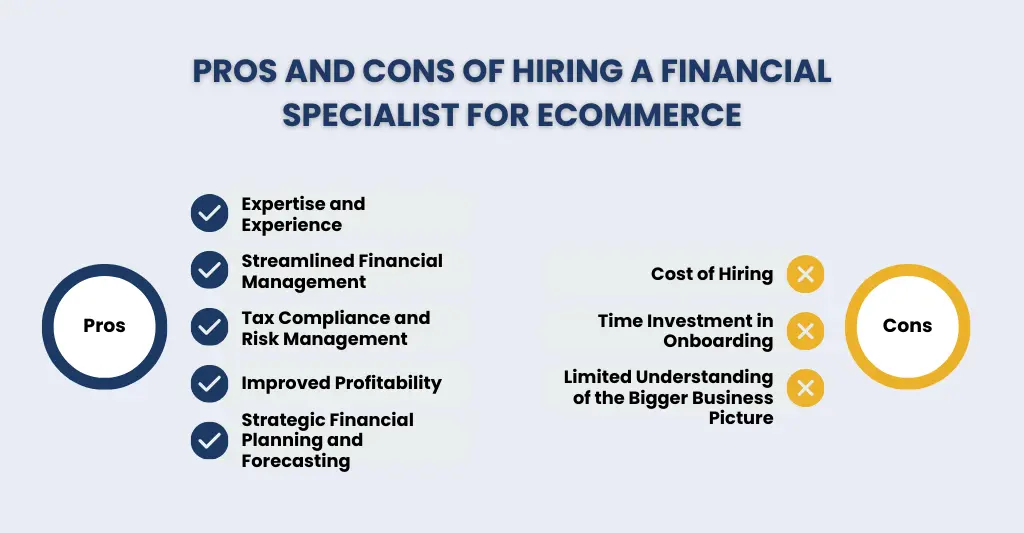
When scaling an eCommerce business, effective financial management becomes critical. While many entrepreneurs attempt to manage their own finances, hiring a financial consultant can provide significant benefits. However, as with any decision, it has both advantages and disadvantages. Here’s an outline to help you decide whether hiring a finance professional is the correct decision for your eCommerce business.
Pros of Hiring a Financial Specialist for eCommerce:
Expertise and Experience: A financial professional, especially one with eCommerce experience, has good industry understanding. They understand the complexities of eCommerce transactions, taxes, cost structures, and compliance, allowing them to deliver customized financial advice that can assist you in making better business decisions.
Streamlined Financial Management: Financial specialists reduce the pressure of managing your finances on a daily basis. From bookkeeping to cash flow management, they ensure that your financial procedures function smoothly, allowing you to concentrate on core business growth and strategy.
Tax Compliance and Risk Management: Navigating the complexity of tax legislation, particularly in a multistate or international eCommerce market, can be difficult. A financial specialist ensures that you comply with all applicable tax regulations, allowing you to avoid penalties, interest, and legal complications.
Improved Profitability: A finance specialist can discover inefficiencies and manage your pricing, costs, and supply chain while keeping an eye on cost-cutting options. Their insights contribute to profit maximization by striking a balance between income growth and controlled spending.
Strategic Financial Planning and Forecasting: Financial experts can foresee future trends, assist you in preparing for seasonal fluctuations, market disorder, and financial setbacks. Their capacity to forecast future financial scenarios allows you to make well-informed, strategic decisions that promote long-term growth.
Cons of Hiring a Financial Specialist for eCommerce:
Cost of Hiring: One of the most major disadvantages of engaging a financial advisor is the related cost. They usually charge fees for their services, which can be rather expensive for small or freshly founded enterprises. The cost-benefit analysis should take into account the worth of their skills as well as your present financial situation.
Time Investment in Onboarding: A financial specialist can provide immediate insight, there may be a learning curve as they get familiar with your business procedures. The onboarding procedure could take some time, especially if your company has complicated financial arrangements or unique difficulties that require extensive explanations.
Limited Understanding of the Bigger Business Picture: Although eCommerce accountants or CPAs have extensive knowledge in financial management, they may not necessarily have a thorough understanding of your overall business operations, marketing plans, or customer experience. This can often result in a misalignment of finance plans and overall business objectives.
Choosing the Right eCommerce CPA for Your Business
Choosing the correct CPA is critical to your eCommerce business. Here is something to consider:
eCommerce Experience: Choose an eCommerce CPA who has previously worked for eCommerce business, sales platforms, and industry specific requirements.
Sales Tax Knowledge: Ensure that the CPA you choose understands the complexity of sales tax regulations, including multi-state compliance.
Multiple Revenue Streams: The CPA should be well-experienced about the various money streams of eCommerce, such as marketplaces, subscriptions, and direct sales.
Financial Forecasting: A qualified CPA can assist with budgeting, forecasting, and growth planning, in addition to compliance issues.
Tech-Savvy: Make sure they are familiar with accounting software and eCommerce technologies to ensure smooth operations.
References: Ask for client references or reviews to analyse their expertise and reliability.
Fee Structure: Understand their pricing model, whether hourly or flat-rate, and ensure it fits your budget.
Managing eCommerce finances doesn’t have to be overwhelming.
Learn how specialized accounting practices help online businesses stay compliant and profitable.
FAQs: Frequently Asked Questions
1. What should I look for in an eCommerce CPA accountant?
Look for an eCommerce CPA with:
eCommerce Experience
Sales Tax Expertise
Financial Forecasting
Tech-Savviness
Clear Communication
2. How can an eCommerce accountant help me save money?
An eCommerce accountant saves money by maximizing eCommerce tax deduction, eliminating needless expenses, and assuring sales tax compliance. They also improve cash flow management and offer strategic financial planning for growth.
3. Do I still need an accountant if I use accounting software?
Yes, an accountant can help interpret software data, ensure compliance, and provide tax planning and financial advice that software alone can’t offer.
4. How often should I talk to my eCommerce accountant?
To be well-informed about the work you should meet an eCommerce accountant at least quarterly to examine financial performance, discuss tax planning, and ensure compliance.
Conclusion:
In the world of eCommerce where the pace is rapid and things can change in a heartbeat , having a CPA with a deep understanding of your industry can be an absolute lifesaver for your business. A good CPA brings a wealth of know-how to the table – that means they can help you stay on top of all the tax stuff, squeeze every last bit of efficiency out of your finances and make smart decisions to grow your business. From sorting out sales tax headaches to fine tuning your financial systems, the right CPA will give you valuable insights that can send your profitability soaring and your operations humming.
Invest in a top-notch CPA and it’s not just about crunching numbers it’s about equipping your business to grow, make long-term plans and tackle the unpredictable eCommerce landscape with confidence.