

If you sell on Amazon and ship products to customers in New York, you’re probably walking on thin ice tax-wise, even if you don’t know it. Amazon FBA Accounting in New York is a nightmare compared to almost any other state – and it’s got this unique, double-whammy system that even seasoned sellers who are all over Ecommerce Accounting in New York, Texas, California, and Florida can get tripped up on.
Unlike most states that make you meet one – either sales or transaction threshold – to trigger a connection to the state, New York hits you with both at the same time. And to make matters worse, New York also slaps state income tax on out-of-state FBA sellers – something most sellers completely ignore. This guide’s got your back, covering everything about Amazon FBA Accounting in New York: nexus rules, income tax filing, end-to-end accounting workflows, and how to pick a specialist who can really protect your business.
Who this Guide is For :
- Amazon FBA sellers shipping to New York customers
- Businesses who are approaching or have already hit that $500K gross receipts threshold
- Sellers who store FBA inventory in New York fulfillment centres
- Multi-channel sellers on Amazon & Shopify
- Ecommerce business owners who need specialist accounting support
New York’s Dual Nexus Thresholds: The AND Rule You Need to Remember
New York’s economic nexus rule is basically as unfriendly to sellers as it gets in the country, and it completely flips the way you have to approach Amazon FBA Accounting if you’re shipping to the state. To have to collect sales tax, you need to meet BOTH of these conditions in the last four quarters:
- $500,000 in gross receipts from sales of stuff that gets delivered into New York
- More than 100 separate sales deals delivered into the state
See the word AND? Most states use the OR test – one or the other, and you’re good to go. New York’s way makes things really complicated. You could have a huge volume of sales, but low prices, so you don’t make enough to trigger it. Or – you make a ton of cash, but only just 90 deals in New York, so again, no nexus. It’s complicated, and the reality is both conditions have to be met at the same time.
Warning: Physical Nexus Has No Threshold – It Applies Right Away
If Amazon stores your FBA inventory in a New York warehouse, you’ve got a physical nexus the moment your goods arrive – no matter how much cash you make, or how many deals you do. Amazon’s got warehouses all over the state, and just by having your stuff stored there, you create a taxable connection the moment the goods arrive. And then there’s Amazon’s inventory placement algorithm – they’ll move your stock around between warehouses automatically, and loads of sellers don’t even know their products have been sent to a New York center.
Once you’ve got a physical or economic nexus, you need to get registered with the New York State Department of Taxation and Finance before you can collect sales tax. And then, how often you file depends on how much tax you owe: usually quarterly, but if you owe more than $300,000 in a quarter, it’s monthly.
Marketplace Facilitator Law – What Amazon Handles – And What It Doesn’t Cover
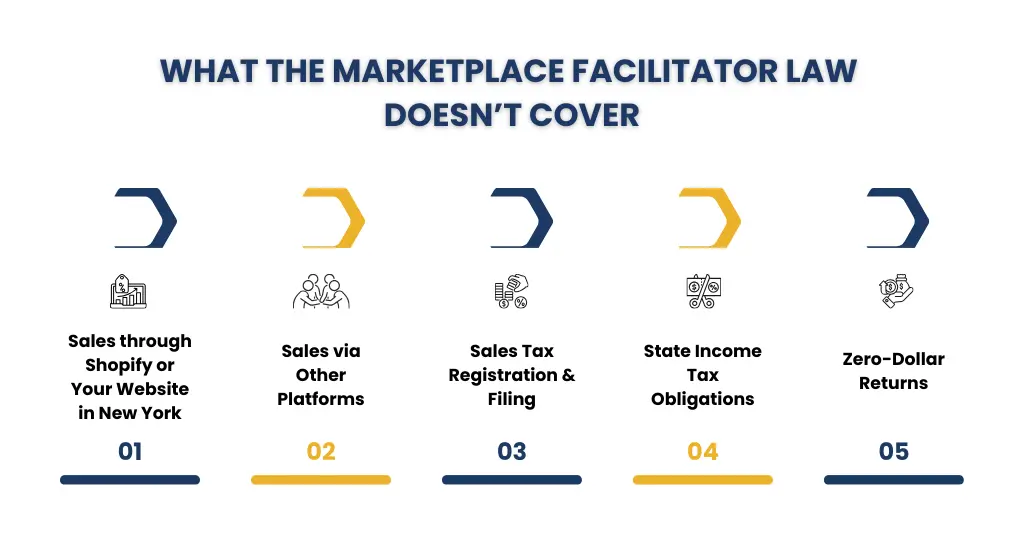
Amazon acts as a marketplace facilitator in New York, collecting and remitting sales tax on behalf of sellers who have transactions processed through the platform. This is a huge weight off the shoulders of most FBA sellers – but it isn’t a complete do-over on compliance obligations. Our team of Ecommerce Accountants deal with sellers all the time who assume Amazon has got everything under control – only to find out that there are loads of gaps in their compliance.
Here’s what the marketplace facilitator law DOESN’T cover:
- Sales through Shopify or Your Website in New York: Any sales you make directly through your Shopify store or your own website in New York
- Sales via Other Platforms: Sales through other platforms that aren’t covered by the marketplace facilitator rules.
- Sales Tax Registration & Filing: The responsibility of registering and filing returns with New York once you’ve established a presence there.
- State Income Tax Obligations: Your obligations when it comes to state income tax – marketplace laws only apply to sales tax.
- Zero-Dollar Returns: Those zero-dollar returns that may be needed to confirm all NY sales are actually marketplace-facilitated.
This is a key point to get your head around – even though Amazon is handling collection and remittance for Amazon-channel sales, you may still need to file sales tax returns in New York. Our team of Ecommerce Accountants and Shopify Accountants work closely together with multi-channel sellers to make sure every platform is properly accounted for and every filing deadline is met.
Selling on Amazon AND Shopify?
Amazon only handles tax collection for Amazon-channel transactions. Your Shopify sales into New York are entirely your responsibility. Our team works together to give you a clear, compliant view of your multi-channel tax exposure – one report, one filing calendar, and no gaps to speak of.
New York State Income Tax – The Hidden Layer Most Amazon Sellers Overlook
Sales tax is just one part of compliance, and state income tax is an entirely separate ball game – and one that gets consistently overlooked in Amazon FBA Accounting workflows. If you have physical nexus through FBA inventory in a New York fulfillment center, or if you’ve crossed the economic nexus thresholds, you may also need to file a New York state income or franchise tax return.
Income Tax Filing Requirements for Different Entity Types
- If you’re a Sole Proprietor or Single-Member LLC, report New York-sourced earnings on Form IT-203 (non-resident) or IT-201 (resident).
- If you’re a Partnership or Multi-Member LLC, file Form IT-204 and get the partners to report their share on individual returns.
- If you’re an S-Corporation, file Form CT-3 and pay the New York corporate franchise tax.
- If you’re a C-Corporation, file the same Form CT-3…
New York uses a market-based approach to apportion income, which means the revenue is assigned to New York based on where the customer receives the product – not where your business is actually located. For Amazon FBA sellers, a chunk of your total business income will be apportioned to New York based on the ratio of your New York sales to your total US sales.
Our Amazon Accountants have handled dozens of New York income tax remediation cases for FBA sellers. Early intervention consistently produces better outcomes than waiting for the state to initiate contact.
End-to-End Amazon FBA Accounting for Sellers
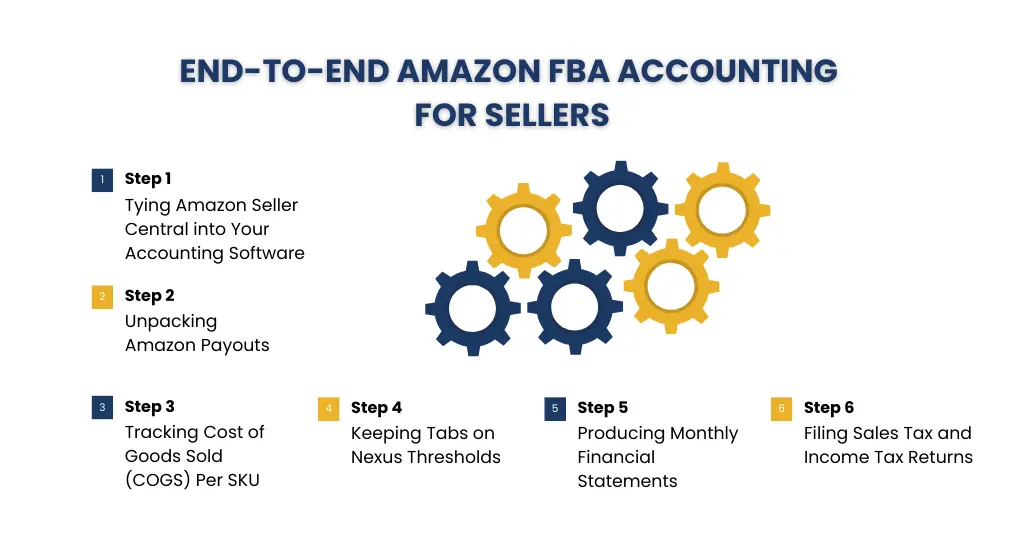
Compliance is the base-line – but it’s only the start. What really matters is having a solid Amazon FBA accounting system in place for New York sellers – one that produces clean books, gives you a real picture of your numbers, and helps you make smarter decisions about your stock and pricing. Here’s how we take care of the whole Amazon seller accounting process for every client:
Step 1: Tying Amazon Seller Central into Your Accounting Software
We need all of that transaction data – sales, refunds, FBA fees, reimbursements, ad spend and storage fees – importing and getting categorized automatically. Good Ecommerce Accounting starts with making sure that data from Seller Central is plugged into QuickBooks, Xero or whatever platform you are using – the right way. I mean, manually entering all that data is a recipe for compounding errors that will be a nightmare to sort out later on.
Step 2: Unpacking Amazon Payouts
Those bi-weekly payouts from Amazon are a real pain to sort through – it’s a single bank deposit net of all fees, refunds and reserves. We need to break it all down into the individual components – gross revenue, FBA fees, referral fees, storage fees, reimbursements, refunds and ad costs. If we don’t, then your P&L is pretty much useless and so is your tax return. Sadly, this is one of the most common pitfalls when people try to do their own book-keeping – and the first thing we get sorted for every new client.
Step 3: Tracking Cost of Goods Sold (COGS) Per SKU
Tracking COGS accurately is the foundation of FBA profitability analysis. We track the costs of inventory, inbound freight, Amazon prep center fees, customs duties and storage costs – for every single product line, so you know exactly which ones are making you money and which ones are quietly bleeding you dry.
Step 4: Keeping Tabs on New York Nexus Thresholds
We keep an eye on your rolling four-quarter New York gross receipts and transaction counts every month. You’ll always know exactly how you stand compared to those $500,000 revenue and 100-transaction thresholds – and we’ll spot any warning signs before you cross the line.
Step 5: Producing Monthly Financial Statements
Every month you get a profit and loss statement, balance sheet, and cash flow statement – and for Amazon sellers, we add in a contribution margin report by product line, inventory reconciliation report and a state nexus exposure summary. These are the statements your accountant, investors and lenders actually need to make sense of your Amazon FBA accounting and to guide your growth decisions.
Step 6: Filing New York Sales Tax and Income Tax Returns
We take care of your whole New York filing calendar – filing sales tax returns with the NY Department of Taxation and Finance on schedule, income or franchise tax returns prepped for your business type, and any federal 1099-K reconciliations needed for your Amazon payouts.
Common Amazon FBA Accounting Mistakes New York Sellers Keep Making
- A lot of people assume Amazon handles all the New York sales tax for them — and they end up ignoring the other tax obligations they’ve got through Shopify
- There’s a knack to registering with the NY Department of Taxation after your FBA inventory has been stored in a New York warehouse and created a physical presence there
- Hiring someone with no experience at all with Amazon FBA accounting is a recipe for disaster, the bi-weekly payouts are a nightmare to get right and trying to figure out the different FBA fee types is a real challenge
- You shouldn’t just record the total Amazon payout as your gross revenue, you need to reconcile it back to what you actually sold, minus all the platform fees and refunds
- People often get caught out by ignoring state income tax obligations, and end up just filing their federal returns without factoring in state franchise or income tax
- Without proper Bookkeeping for Ecommerce in place, you’re going to be left with inaccurate COGS and either overstating or understating your profit
- Not keeping an eye on FBA inventory placement reports can mean you miss the fact that Amazon has moved stock into a New York fulfilment center.
Every single one of these mistakes can be fixed – but the longer they go on, the more expensive they become. Our Ecommerce bookkeeping specialists and multi-channel experts work with Amazon and Shopify to catch and resolve these issues before they spiral out of control and leave you facing a state audit or a multi-year back-tax bill.
What we do – Our Services Across the United States
We provide specialist Amazon FBA accounting and ecommerce accounting services in all of the major seller states. Each state has its own rules, filing requirements, and tax obligations, and our teams are built around that state-specific expertise.
Our Ecommerce Accounting Services:
- Ecommerce Accounting in New York: We’ve got Amazon FBA accounting, dual-threshold nexus, NY income tax and multi-channel bookkeeping covered
- Ecommerce Accounting in Texas: We help with FBA nexus compliance, franchise tax planning and even a no-state-income-tax strategy
- Ecommerce Accounting in California: We sort out CDTFA registration, the $500K nexus threshold and multi-county local tax rates for you
- Ecommerce Accounting in Florida: We look after marketplace facilitator law, the $100K nexus threshold and FBA compliance for you
Need Ecommerce accounting in New York for your Amazon FBA business, or need to keep a handle on your compliance obligations across multiple states? Our national team has got every filing, every threshold and every deadline covered
Book a Free Amazon FBA Accounting Consultation
Our specialist team delivers Ecommerce Accounting in New York, Texas, California, and Florida. Get a free nexus assessment and Amazon FBA Accounting review today.
FAQs: Frequently Asked Questions
Does every Amazon FBA seller in New York need to be worried about sales tax?
Probably – but not without exception. The thing is, if you’ve ever had inventory stored in a New York Amazon fulfillment center at any point, you automatically qualify as having a physical presence in the state, even if you’ve got no income to report. And that’s before we even get to sellers who just sell through Amazon with no physical presence – you’ll still need to keep an eye on those $500,000 revenue and 100-transaction thresholds. One way or another, Amazon FBA Accounting in New York is a bit of a headache – and you need to be keeping on top of it from the very first sale you make into the state.
Is New York’s income tax separate from the sales tax you need to be paying?
Absolutely – they are two completely separate things. Sales tax is all about collecting money from your customers and then passing it on to the state. Income or franchise tax, on the other hand, is about taxing your business profits – or at least, its gross receipts, depending on whether your business is set up as a partnership or a corporation. Lots of Amazon sellers get the sales tax a bit right, but they have no idea they’ve got an income tax problem looming in New York.
What accounting software works best for Amazon FBA sellers ?
QuickBooks Online and Xero are the favourites among FBA sellers when it comes to ecommerce bookkeeping and amazon fba accounting. We’ve got Seller Central data feeds plugged straight into your accounting software , so every transaction, every single fee and every refund gets automatically categorized – no more tedious manual reconciliation errors to worry about, and no more DIY disasters.
How do I know if I need a specialist accountant or just a generalist?
If your accountant has never had to deal with an Amazon bi-weekly payout, doesn’t know the difference between fba fulfillment fees and referral fees, or has never touched marketplace sales tax laws then they’re not exactly equipped for FBA compliance. Ecommerce bookkeeping requires a level of platform know-how that most general accountants just don’t have.
Conclusion : Get a solid Amazon FBA accounting foundation that will last
New York is one state where Amazon sellers have it tough – the dual-threshold nexus rules, the risk of getting nailed for physical nexus from FBA warehouse storage, state income tax obligations that vary by entity type, and don’t even get us started on the never-ending nightmare of reconciling Amazon payouts, tracking COGS, and filing on time. That’s way too much to ask from some generic bookkeeper or a one-off tax filing. You need specialist amazon FBA accounting support that understands every single layer of New York compliance and every single line item in your Seller Central account.
Whether you’re approaching the $500,000 threshold for the first time, storing FBA inventory in a New York facility without even realizing it, or juggling sales across Amazon, Shopify and other channels across multiple states – our team of expert amazon accountants is here to give you a clean, compliant and scalable accounting base to build on. We provide ecommerce accounting in New York, Texas, California and Florida with the state-specific know-how to keep your margins safe and your business on track.