

Did you pick up and move to a new city last year for a job? Or are you like a lot of folks, running an online store that sends packages all over the country from a beachside office in Florida, even though your employer is back in New York? If any of this sounds like your situation, then you know exactly what it’s like to be one of the millions of Americans who need to file multi State tax returns in more than one state every year. And yeah, it can be a real pain. But it doesn’t have to be.
Multi state tax filing is the process of filing income tax returns in more than one state. This happens when you live in one place, earn income somewhere else, or move during the tax year. With the rise of remote work and ecommerce, it’s getting more and more common for people to need to file in multiple states – and it’s becoming a source of a lot of confusion.
This step by step guide is designed to walk you through everything you need to know – from figuring out the rules about residency to navigating all the different state tax laws, dealing with sales tax for your online store, and knowing when its time to bring in a pro.
How Moving States Affects Your Tax Filing
Moving from one state to another during the year can make a real mess of your tax filing situation. Each state has its own rules about who has to file and what income counts as taxable. Most states tax residents on income they earn anywhere in the world, but non-residents only pay on income earned within their state.
Real-Life Example:
Sarah makes the big move from Illinois to Texas in June. Illinois has a flat income tax rate and so she has to file a part-year resident return for the months she lived there – which is a bit of a pain. But Texas, on the other hand, doesn’t have a state income tax – so Sarah owes nothing to the state of Texas. Still – she’s got to file in Illinois and be super careful about how much income she earned while she was living there.
Figuring all this out early in the year can save you a whole lot of hassle, money and stress come April.
How to File Taxes in Two States Or More
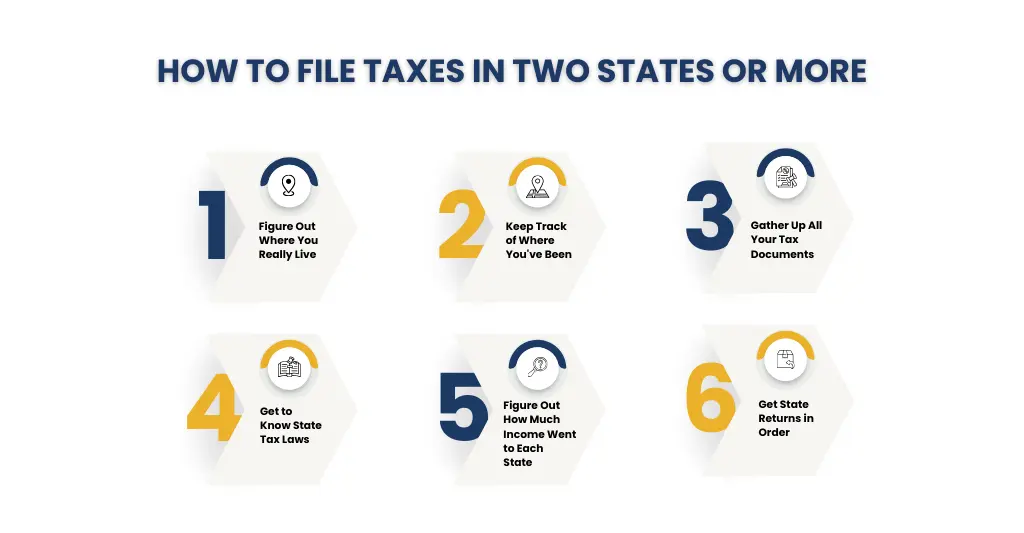
Step 1: Figure Out Where You Really Live
Where you live – or at least where the taxman thinks you do – is really important when it comes to filing state tax returns. There are basically three kinds of categories for this:
- You’re a full-time resident: You lived in the state all year, no question about it.
- You’re a part-time resident: Your plans to live in the state went awry, and you ended up only being there for part of the year.
- You’re just a visitor: You worked in a state, but you didn’t actually live there.
Step 2: Keep Track of Where You’ve Been
Write down the dates of every time you’ve lived in a new state this past year. This list is going to help you get your multi-state tax filing in order. Include all those temporary stints – even just a few weeks in a state like California – because they might come back to haunt you when tax time rolls around.
Step 3: Gather Up All Your Tax Documents
You can’t file your taxes accurately without the right documents. You’re going to need to collect the following before you even start:
- All of your W-2 forms from every job you worked at, taking note of which state you earned your wages in
- 1099 forms if you did some freelance work, took on a contract job or made some investments
- Records of any rental income you had in any state
- Any sales records if you had an ecommerce business (particularly important for ecommerce accounting in Florida, Texas, California, and New York – places where they have special rules)
Step 4: Get to Know State Tax Laws
State tax laws vary so wildly – in some places you can be taxed on income you earned all around the world, and they’ll even come after you if you move away but still have ties to the state. California’s a prime example – if you used to live there, they might still go after you for taxes even if you’re long gone. On the other hand, Florida and Texas don’t even tax people who live there. And then there’s New York – they’ve got all sorts of rules about telecommuting – if you’re an employer in New York and you have people working remotely elsewhere, you might still owe New York state taxes. Always be sure to check up on the specific rules of each state before you file your taxes.
Step 5: Figure Out How Much Income Went to Each State
You need to split up your income between states. If you’re a part-year resident, this usually means just dividing up your income by the number of months you lived in each state. If you’re a nonresident, you figure out how much of your income was earned in each state. Many states have worksheets in their tax forms to help you out with this.
A Real-Life Example:
Lets say you’re a software consultant, you lived in Colorado for most of the year but then moved to Arizona for a bit. You made $120,000 total. You’d split that up so you allocated 80 grand (2/3 of your income) to Colorado and 40 grand to Arizona – file part-year returns for each state, and make sure to claim a credit in Arizona for those taxes you paid to Colorado so you don’t get double taxed.
Step 6: Get State Returns in Order
Always file your federal return first – most state returns pull from your federal adjusted gross income. Then file your state returns, starting with your home state. If you paid taxes to another state, your home state will usually let you claim a credit for those taxes, so you don’t get double taxed.
How to File Taxes When You’ve Lived in Two States
If you’ve moved between states, you’ll need to file 2 part-year resident returns. Each state will only want to know about the income you earned while you were a resident. Make sure you keep a record of the date you moved – a utility bill, lease agreement or voter registration card can all count as proof.
Filing Taxes Across State Lines: The Basics
If you work in one state but live in another, you might need to file a nonresident return in your work state and a resident return in your home state. Check if the two states have a reciprocity agreement – if they do, you may only need to file in your home state. Some states like Maryland, Virginia and Washington D.C. all have reciprocity agreements with each other.
Note on Ecommerce Businesses:
If you have an ecommerce business in California, you need to be super careful about tracking your sales tax nexus as they have strict rules about when you need to start charging taxes. Similarly, Ecommerce Accounting in New York involves complex sales tax rules on digital products. For Ecommerce Accounting in Texas and Ecommerce Accounting in Florida, there are no state income taxes, but sales tax compliance is still mandatory. Ecommerce sellers must understand nexus rules in every state they ship to.
Can I Just Double Check My State Tax Returns Are All Ready Before I File?
For sure — and you should. Here’s a quick checklist to make sure you’re good to go:
- Have you already filed your federal return? That’s the first thing to get out of the way.
- Did you file a return for every state where you worked or lived? All those states need to be accounted for.
- Have you claimed the credits you’re owed for taxes you paid to other states on your resident return? Don’t miss out on that refund.
- Are your income allocations all lined up across all your state returns? Consistency is key here.
- Have you looked over each state’s specific deductions and credits you might qualify for? You don’t want to miss out on any savings.
Special Scenarios & Some Tips
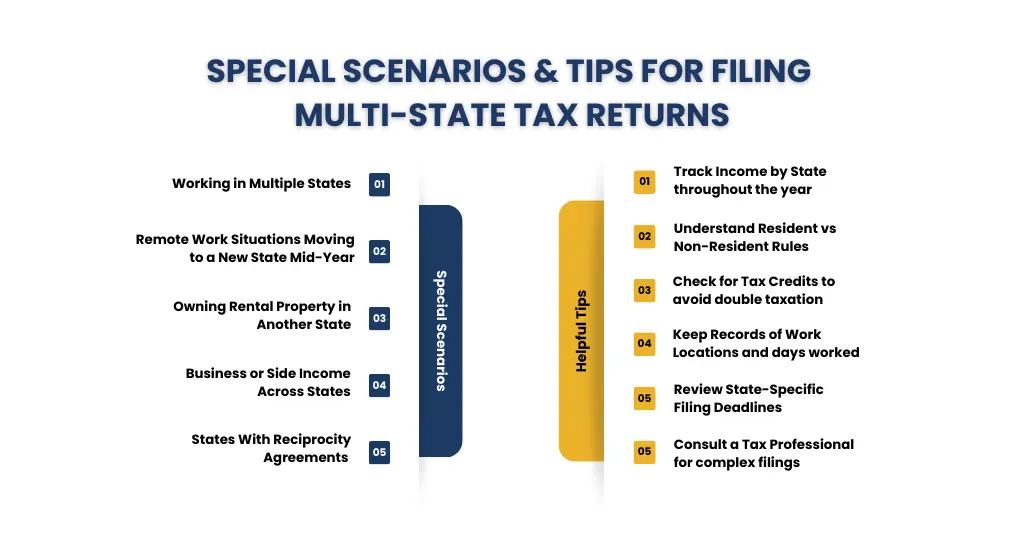
What’s This Reciprocity Business?
Reciprocity agreements between states let people who live in one state work in another state, but only pay taxes in their home state. That’s a big deal. For example, if you live in New Jersey but work in Pennsylvania, you only have to file a New Jersey return. That takes a big weight off your shoulders. There are currently something like 30 states participating in reciprocity agreements, but they can change so always check for the latest.
What Happens if I Live in a State with No Income Tax?
Nine states – Florida, Texas, Nevada, Washington and a few others – don’t have state income tax. That can make multi-state filing a lot simpler on one end. However, watch out: some no-income-tax states have higher property taxes or sales taxes to make up for it, which can affect your business income tax planning.
Self-Employed People – A Whole Different Ball Game
Self Employed People – a Whole Different Pitch If you’re out there on your own as a freelancer or self employed, things can get a whole lot trickier. Chances are you’ll be footing the bill for estimated taxes in multiple states throughout the year – depending on where the work took place and who your clients are. Its a good idea (no kidding, but seriously) to keep track of where each job took place – especially if you’re having to travel for clients.
Common Mistakes to Steer Clear of
- Don’t be a numpty and forget to file a non-resident return – a tiny bit of income from another state is still enough to trigger a return in the other state
- Make sure you’re not counting your income twice – if you don’t get tax credits right then you could end up paying the same taxes twice on the same income
- Don’t get the domicile rules mixed up – states like New York have some pretty strict rules about where you live and if you get it wrong then you’ll know about it
- Don’t sleep in and miss the deadlines – different states have different deadlines and some even have different rules for extensions.
Some states will give you an automatic extension if you file a federal one, but others need a separate request. Always check the state revenue website for the current year’s deadlines.
Before you go — grab our FREE guide: 7 Costly Multi-State Tax Mistakes and How to Avoid Them.
Simplifying Your Multi-State Filing
Taming the Beast of Multi-State Filing Tax software like TurboTax, H&R block and Tax Act can help make multi state filing a whole lot easier. They will walk you through income allocation and most charge an extra fee for each state return. And if you sell stuff online you might need to use a platform like TaxJar or Avalara – they can sort your sales and use tax calculations for you across all the states. If things are getting really complicated (multiple states, self employment, rental properties) then it might be worth splurging on professional tax software designed with CPAs in mind.
Deadlines and Staying Compliant
Deadlines to be Kept in Mind Most states will require you to file your income tax return by the 15th of April – just like the federal deadline – but not all states. For example, Virginia’s deadline matches the federal one, but in Delaware it’s a different story altogether. Some states will automatically give you an extension if you file a federal one, but others require a separate request. Missing a state filing deadline can result in penalties and interest — even if you do not owe any tax.
Business Income Tax in Multi-State Tax Filing
Businesses spread across a few states have got a thing called apportionment – essentially, you split your total business income between states according to some formula, typically with sales, payroll and property in each state going into the mix. For small business owners, LLCs and S-Corps, this means filing business income tax returns in just about every state where they’ve got a real presence – or nexus, as it’s called. The rules vary pretty wildly: some states use a super simple formula that’s just one factor – sales, say – while others are a bit more complicated: three different factors to consider.
A Real-Life Example:
Maria runs a marketing agency out of California and she’s got clients in New York, and Texas. And she also has employees in all three places. So, Maria’s got to file business income tax returns in California – and New York – and then carve up her business income according to where her employees work and where the money is coming from.
Sales and Use Tax Headaches in Multi-State Filing
After the Supreme Court’s decision in South Dakota vs Wayfair back in 2018, states can now force out-of-state sellers to collect and pay sales and use tax, even if they don’t have a physical presence, as long as they meet some basic sales and transaction threshold – $100,000 in sales, or 200 transactions a year. This really shook up the ecommerce world.
Ecommerce sellers now have to deal with a whole other level of sales and use tax compliance. Whether you’re handling your taxes in California, New York, Florida, or Texas – or somewhere else – you need to get a handle on the nexus threshold – tax rates – and exemptions in every state you’re selling to. If you’re moving lots of products, you’re gonna need some help with this.
When Getting a Pro Makes Sense
When you add in business income, rental properties, stock options, and trust distributions all happening across state lines, multi state tax returns can get really complicated. If you’re self-employed in a bunch of different states, you run an ecommerce business with customers all over the country, or your income comes from some business that operates across multiple states – the peace of mind that comes with hiring a tax pro who specializes in multi-state tax returns will almost certainly save you more in the long run than it costs.
A tax professional can sniff out state-specific credits and deductions that you might have otherwise missed, keep an eye out for any potential audit issues by making sure your income is properly allocated, and give you reassurance that all your filings are spot on and compliant.
Not sure which states you need to file in? Get a free multi-state tax assessment from our experts today.
FAQs : Frequently Ask Question
What are multi state tax returns?
Multi state tax filing returns are the tax returns you file with more than one state – i.e. you’ve got to deal with the tax authorities in two or more places.
When do I need to file my tax return?
Most state tax returns are due on April 15, aligning with the federal deadline. However, some states have different due dates or extension rules. Always check each state’s revenue department for current deadlines.
What happens if I don’t file a required nonresident state tax return?
Failing to file a required state return can result in penalties, interest on unpaid taxes, and potential legal action from the state. Some states actively cross-reference federal data to identify unfiled returns.
Do nonresident aliens need to file a tax return in the U.S.?
Yes, nonresident aliens who earn income from U.S. sources must typically file a federal tax return (Form 1040-NR) and may also need to file state returns in states where they earned income, depending on each state’s rules.
When is the deadline to file my tax return?
The federal tax deadline is typically April 15. Most states follow the same deadline, but some differ. Extensions are available in most cases, though an extension to file is not an extension to pay — you may still owe interest on unpaid tax after the original deadline.
Conclusion
Multi-state tax filing’s a real headache, but with the right mindset it’s doable. You just need to get a good grasp on your residency status, keep your tax documents in order, and learn the state tax laws that apply to you. Then, break down your income into manageable chunks, and you’ll be fine. Whether you’ve upped sticks and moved for a new job, you’re a remote worker dealing with a bunch of different states, or you run an ecommerce business and have to juggle sales and use tax across states – staying on top of things is the key to getting your multi state tax returns done without getting fined for it.
Don’t let multi-state filing stress you out. We handle everything — from residency analysis to filing in all required states. Get started today.